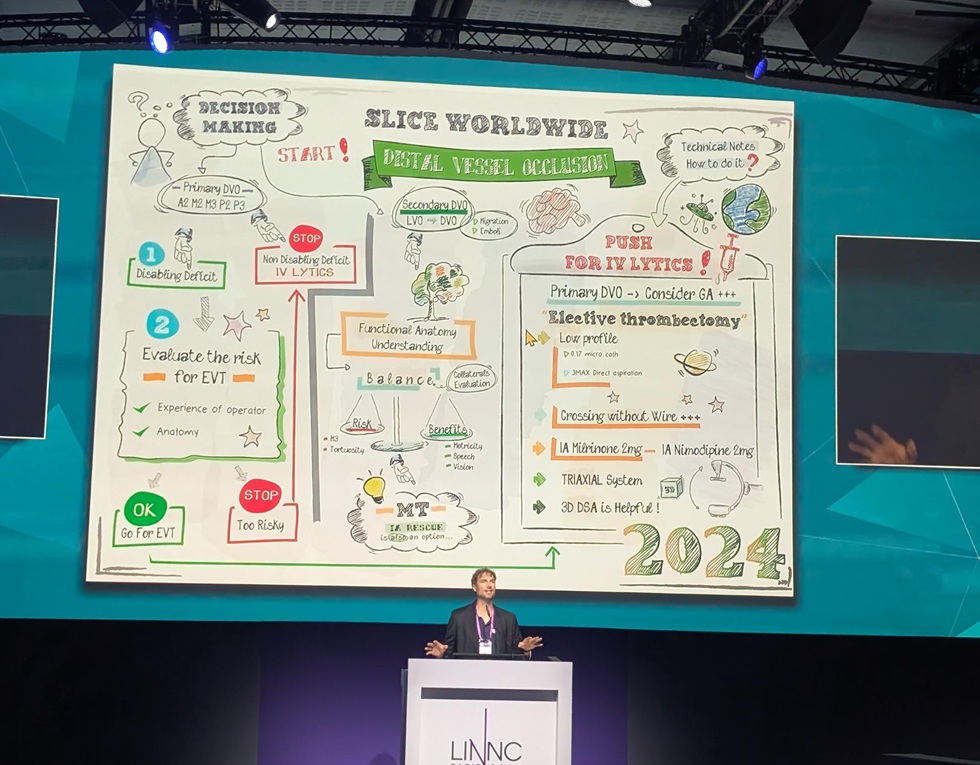
Owing to the “confusion” created by recent randomised controlled trials (RCTs) evaluating mechanical thrombectomy in more distally located stroke-causing occlusions, the neurointerventional community should shift its focus away from traditional, location-based definitions in favour of a simpler and more reproducible paradigm centred around vessel diameters. That is according to Vincent Costalat (University Hospital of Montpellier, Montpellier, France), who stated that “we need to completely rethink these inconsistent anatomical definitions” while introducing this updated concept at the 2026 LINNC Paris course (1–3 June, Paris, France).
Costalat began by recapping the findings of three RCTs—the DISTAL, ESCAPE-MeVO and DISCOUNT studies—that were designed specifically to evaluate thrombectomy’s benefits in ischaemic strokes caused by primary distal or medium-vessel occlusions (D/MeVOs), but ultimately failed to demonstrate superior efficacy over standard medical care. Additionally, interim analyses from the prematurely halted DISCOUNT trial revealed potential safety concerns with the procedure.
However, while these negative results appear to be partially responsible for a “significant drop” seen recently in mechanical thrombectomy usage in more distally located occlusions, this landscape “started to become confusing” following the presentation of the DISTALS and ORIENTAL MEVO trials earlier this year, according to Costalat.
“We cannot attribute exactly the same level of evidence to DISTALS—it was very well-performed, but this is an industry-sponsored trial with only 100 patients,” he added, also stating that, while the previous trials used clinically led primary endpoints relating to modified Rankin scale (mRS) scores, the DISTALS investigators selected successful reperfusion as their primary endpoint of choice.
Nonetheless, Costalat continued, the trial did find that patients randomised to undergo thrombectomy with a tailored, low-profile stent retriever achieved statistically significantly higher reperfusion rates compared to those receiving standard care, while “almost no complications” were reported. Additionally, a trend towards improved rates of mRS 0–1 with thrombectomy versus standard care was observed.
“And, even more importantly, we now have an RCT—with a similar design to the earlier negative trials—that is significantly positive on both mRS 0–1 and mRS 0–2,” Costalat said, referring to ORIENTAL MEVO. “So, now we have three negative trials and two positive trials, what should we do? That is the big question.”
Diving deeper
Providing a closer look at the data from these five discrepant studies, Costalat highlighted the delivery of intravenous thrombolysis (IVT) as being “very different” between the positive and negative groups of trials. More than half of the patients in both study arms in DISTAL, ESCAPE-MeVO and DISCOUNT received IVT, compared to 0% in DISTALS and roughly one third in ORIENTAL MEVO.
“In DISTALS, you are basically comparing the patient’s natural history versus mechanical thrombectomy,” the speaker noted. “But, in the negative trials—where you had best medical therapy with or without IVT—there was a rate of up to 75% of good outcomes in M2 occlusions treated just with IVT. Trying to show thrombectomy is superior to this is much more difficult, whereas, without IVT, you are only fighting against the natural history of the patient. That is the main reason why we now have these positive trials.”
Furthermore, according to Costalat, the reason many centres have stopped regularly deploying thrombectomy in more distal occlusions is likely due to the safety signals observed to date, with the procedure being associated with a trend towards increased occurrence of symptomatic intracranial haemorrhage (sICH) across the positive and negative RCTs alike. This is despite overall complication rates remaining low with no statistically significant between-group differences in all trials except DISCOUNT.
“We may feel that this signal of complications with thrombectomy is due to the technique—stent retrievers were the most commonly used modality in most of the trials,” he continued. “But, when you compare subgroups using aspiration versus stent retrievers, you don’t see a clear difference regarding the safety profile.”
Costalat then described the current guidelines on D/MeVO thrombectomy practices as “extremely conservative”, leading to fewer operators performing these more complex and technically demanding procedures.
“But,” he posited, “many operators observe a clear benefit in the real world, and I think that’s the problem. We have some patients with more distal occlusions who are reopened and they are doing much better after just a few hours. There is a mismatch between RCTs and daily clinical practice.”
A new paradigm?
Arriving at the fulcrum of his presentation, Costalat shared various versions of the same patient anatomy on angiographic imaging, highlighting occlusions in multiple different hypothetical locations before conducting audience polls to ascertain which of these occlusions they would personally treat via thrombectomy. These crude surveys produced a diverse range of responses—even revealing disharmony regarding different occlusions in similarly distal locations, despite the fact many of these occlusion types were considered equally suitable for thrombectomy in the aforementioned randomised trials.
As such, Costalat averred that—in clinical practice—it is actually vessel diameter, often coupled with the degree of tortuosity, that drives a neurointerventionist’s decision to perform a thrombectomy, as opposed to solely occlusion location.
“This is an experience we all share, but it is difficult to translate it into systematisation and reproducible decision-making,” he added, alluding to the nuanced nature of each individual acute stroke case. “What we know is that the diameter is at least measurable, and it has been proved to be linked to safety. There is a very interesting article from Virtanen et al showing that, when you go after an occlusion with a device that is 1.2 times the vessel diameter, you increase the risk of sICH threefold.
“The risk-benefit balance probably should not be dictated by the anatomic location, because you make the decision intuitively based on the full picture on the final angiogram. And, the bigger the vessel, the bigger the benefit, because the part of the brain that is supplied by this artery is larger—but, also, the safety profile of the intervention is better. This means the risk-benefit ratio is primarily defined by the vessel diameter.”
Costalat subsequently proposed the introduction of a new definition: small-vessel occlusion (SVO). In his view, this offers a simple, diameter-based concept intended to replace the “inconsistent” anatomical definitions that are used presently. To demonstrate his point, Costalat stated that A2, M2 and M1 occlusions located in a 2.3mm-wide vessel are all likely to carry the same risk-benefit ratio, as are M3, P1 and distal M1 occlusions in vessels with a diameter of 1.2mm.
Defining these vessel-diameter thresholds will involve looking back over the imaging information from all of the D/MeVO thrombectomy RCTs conducted up to now, with these pooled datasets and digital subtraction angiography (DSA) review being key to identifying “clinically meaningful diameter cutoffs”, according to Costalat.
“So, what should we do in 2026?” he concluded. “Select patients carefully—of course—focus on vessel diameter, and support ongoing trials to continue evidence-based innovation. DISTAL 2 and ESCAPE-MeVO 2 are on the way, and I hope they will help us to define the vessel-diameter threshold, because we know this is the key. There is too much variability between proximal M2s, distal M2s, proximal A2s, and so on, and this is not reproducible.”