
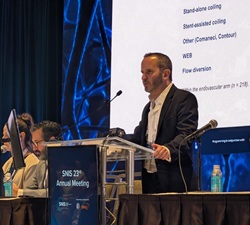
In the treatment of select ruptured wide-neck intracranial aneurysms, microsurgical clipping can achieve clinical outcomes on par with those obtained via endovascular techniques, according to new data from EVERRUN-2—a multicentre, prospective registry spanning seven US institutions. These findings were shared by Justin Mascitelli (UTHealth, San Antonio, USA) during a late-breaking abstract session at the 2026 Society of NeuroInterventional Surgery (SNIS) annual meeting (20–24 July, Seattle, USA).
Mascitelli concluded—based on these data—that microsurgery “should remain in the armamentarium” for physicians treating ruptured wide-neck aneurysms, also reporting that rates of incomplete occlusion and retreatment remain “substantially higher” with endovascular therapy.
The overall EVERRUN registry included a total of 301 ruptured wide-neck aneurysms—those with necks ≥4mm or a dome-to-neck ratio >2—with 218 being treated endovascularly and 83 treated surgically. Mascitelli relayed that, within the registry’s endovascular arm, the most common treatment modality was balloon-assisted coiling (42.7%) followed by standalone coiling (40.8%), with stent-assisted coiling (5%), intrasaccular systems (4.1%) and flow diversion (2.3%) being utilised more sporadically.
Aneurysm location information was available for all 301 cases, and demonstrated that the anterior communicating artery (ACoA), and the internal carotid artery (ICA)-posterior communicating artery (PCoA)/foetal posterior cerebral artery (PCA), were the most common locations for endovascular therapy, at rates of 34.4% and 28.4%, respectively. The middle cerebral artery (MCA) was the most frequent location for microsurgery at 47%. Overall, a higher ratio of anterior-circulation aneurysms were treated microsurgically (97.6%) versus endovascularly (87.2%).
As per the registry’s primary clinical endpoint, rates of a modified Rankin scale (mRS) score 0–2 at one year were comparable between microsurgical (74.3%) and endovascular (75.7%) approaches. Analyses of the primary angiographic endpoint—retreatment, which Mascitelli said was used as a surrogate for occlusion-related failure—occurred at a rate of 0% with microsurgery versus 37% with endovascular techniques. He also noted that final Raymond-Roy occlusion classification grading is “ongoing”.
Furthermore, secondary endpoints of interest revealed parity in terms of ventriculoperitoneal (VP) shunt usage, and treatment-related stroke, but symptomatic vasospasm was found to be more frequent in the microsurgery group (42.2%) compared to the endovascular group (27.6%). Two episodes of rebleeding and one retreatment-related death occurred in the endovascular arm as well.
Prior to concluding, Mascitelli reported the findings of propensity-matched analyses including 81 “well-balanced” patients from each group. Rates of mRS 0–2 at both discharge and one year were statistically similar between microsurgery and endovascular therapy. However, retreatment was “persistently higher” in patients treated via endovascular techniques.
Mascitelli acknowledged the limitations of this research, including its non-randomised nature, relative lack of power and minimal number of cases utilising intrasaccular devices, but also highlighted its strengths: EVERRUN-2 was conducted in a real-world setting, employed “rigorous” outcomes, and addresses a gap in the current literature.
“A true RCT [randomised controlled trial] may be challenging, but larger, prospective analyses with rigorous methodology and propensity matching should be pursued,” he concluded.