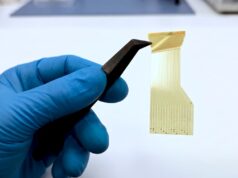
 Paradromics has announced that it has demonstrated more than four years of stable neural recording and decoding performance in two sheep implanted with the company’s cortical modules, representative of the electrode technology used in the Connexus brain-computer interface (BCI). Through ongoing follow-up, the animals have remained healthy, no electrode-array migration has been observed, and recorded neural signals have remained stable leading to durable neural decoding performance.
“This is an important proof point,” said Matt Angle, founder and chief executive officer (CEO) of Paradromics. “It has commonly been assumed that implantable BCI architectures must trade between peak performance and long-term stability. Entire companies have been based on that premise. Now, we have shown that our platform, which has demonstrated the highest information transfer rates of any BCI, can also record stably for years. It’s possible to achieve both performance and longevity in one architecture.”
Across the four-year study period, spike signal-to-noise ratio (SNR) remained stable in both animals, meaning neural spikes remained clearly distinguishable from background noise years after implantation. In another ongoing study of the full Paradromics BCI platform in six sheep, spike SNR has also remained stable for nearly two years.
“Our responsibility as a preclinical science team is to move past demos and develop rigorous internal benchmarks to ensure that we are building a platform that the clinical team can use to develop durable therapies,” commented Shaoyu Qiao, vice president of neuroscience at Paradromics. “We designed the system to be stable in vivo. We used materials that we knew would last, we developed a surgical approach that avoids electrode migration, and we made the microwires that penetrate smaller than a human hair in order to reduce biological impact. We are achieving what we set out to achieve, but this is just the first four years of what we hope will be many more years of ongoing performance.”
The Connexus BCI is designed to capture individual neuron resolution information at a high data rate, to be fully implantable using medical-grade materials and established neurosurgical workflows, and to support years of stable neural recording, Paradromics claims. The company is continuing long-term preclinical follow-up as part of its broader effort to establish the evidence required for safe and durable high-performance BCI technology.
“I have long endorsed that a BCI has to be safe, high performance and durable to matter clinically,” added Stephen Ryu, chief medical officer of Paradromics. “The field tends to focus on the first two. But, as a neurosurgeon, I see durability as a safety issue. Every additional surgery is asking the patient to take on another round of risk. Ideally, no one should need repeat brain surgery because their implant wore out. Durability may be the most important factor for a technology that’s meant to be widely adopted. At Paradromics, our goal is a single implant that lasts as long as the patient needs it. Data like these show that’s achievable.”