
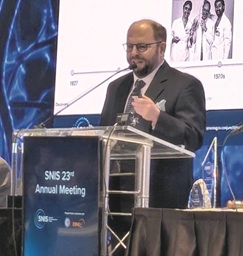
In an adaptation of the Grant Hieshima Luminary Lecture he delivered at this year’s Society of NeuroInterventional Surgery (SNIS) annual meeting (20–24 July, Seattle, USA), Joshua A Hirsch (Los Angeles, USA) explores a “continuing cycle” of innovation, clinical evidence and health policy, as well as the neurointerventional specialty’s duty to shepherd this process forward.
Neurointervention is a specialty built on innovation. Over a remarkably short period, we have transformed our ability to diagnose and treat diseases of the cerebrospinal axis. Procedures that would have seemed unimaginable to an earlier generation are now routine. Reflecting on several decades in the field, I have come to appreciate that technical innovation is only the beginning of a much longer journey. For an advance to achieve its potential, it must be evaluated through rigorous evidence, incorporated into clinical practice, and supported by healthcare policies that enable appropriate patient access.
Innovation creates possibilities. Evidence establishes value. Policy determines access. These elements are closely interconnected, although their relationship is rarely as linear as that formulation suggests.
From possibility to clinical reality
The history of neurointervention illustrates the extraordinary power of physicians and scientists willing to challenge established boundaries. Cerebral angiography, introduced by Egas Moniz in 1927, provided the diagnostic foundation. Sven Ivar Seldinger’s catheterisation technique, developed in 1953, made increasingly sophisticated endovascular procedures possible. Pioneers including Alfred Luessenhop and Fedor Serbinenko subsequently demonstrated that catheters could be used not simply to visualise disease, but to treat it.
When I entered neurointervention in the 1990s, the specialty was transitioning from invention toward maturation. Detachable coils were transforming aneurysm treatment, while advances in microcatheters, guidewires and embolic agents were rapidly expanding our capabilities. These developments reflected an important characteristic of our specialty: innovation rarely arises in isolation. It depends on collaborations among physicians, engineers, scientists and industry, often extending across institutions, countries, and traditional specialty boundaries.
The subsequent evolution of mechanical thrombectomy provides perhaps the most dramatic contemporary example. Early endovascular approaches to acute ischaemic stroke were technically promising, but achieving reperfusion was not equivalent to demonstrating improved clinical outcomes. Device development was essential, yet it was only one component of the transformation that followed.
Two different journeys
The modern history of thrombectomy demonstrates what can happen when technological innovation and convincing clinical evidence converge. The 2013 randomised studies failed to establish the expected benefit of endovascular stroke treatment but—following refinements to patient selection, imaging protocols, devices and treatment workflows—multiple landmark trials reported in 2015 fundamentally changed the landscape. For appropriately selected patients with emergent large vessel occlusion (ELVO), thrombectomy produced substantial improvements in functional outcomes.
The implications extended far beyond the angiography suite. Stroke systems of care were reorganised, referral pathways evolved, and hospitals invested in the infrastructure necessary to deliver time-sensitive endovascular treatment. Here, evidence did more than validate an innovation; it transformed the organisation of care.
The experience with vertebral augmentation offers a contrasting yet equally instructive history. Vertebroplasty originated in France in the 1980s as a treatment for painful vertebral haemangiomas. Its subsequent extension to osteoporotic compression fractures represented an important conceptual shift: from treating a destructive vertebral lesion to relieving pain and restoring mechanical stability.
As the technique spread, clinical experience and observational studies suggested substantial benefit. Randomised trials including FREE and VERTOS II subsequently demonstrated advantages over non-surgical management. Then, in 2009, two sham-controlled trials published in the New England Journal of Medicine challenged prevailing assumptions about vertebroplasty. Neither demonstrated superiority over sham treatment for its principal outcomes, and the resulting controversy was profound.
Subsequent studies—including the positive VAPOUR and VERTOS V trials, along with a growing mortality literature—provided additional evidence supporting the value of augmentation in appropriately selected patients. Unlike the relatively decisive turning point represented by the 2015 thrombectomy trials, vertebral augmentation has followed a more contested evidentiary path.
These histories illustrate an essential principle: evidence must be evaluated in the context of the question a study was designed to answer. A randomised trial comparing intervention with usual care addresses a different question from a sham-controlled trial. Neither should be interpreted beyond its design and population. Ultimately, the question is not simply whether a procedure works. It is which patients benefit, under what circumstances, and compared with which alternatives.
Translating evidence into access
Even compelling clinical evidence does not automatically translate into widespread patient access. The rapid evolution of mechanical thrombectomy required changes in stroke systems, institutional capabilities, clinical guidelines, and reimbursement structures. A highly effective treatment has limited value to a patient who cannot reach an appropriately equipped hospital in time. This is where healthcare policy becomes inseparable from clinical innovation.
In the USA, the Current Procedural Terminology (CPT) system provides the language through which medical services are described. The American Medical Association’s Relative Value Scale Update Committee (RUC) recommends physician work and resource valuations, while the Centers for Medicare & Medicaid Services (CMS) establishes Medicare payment policies. These processes may seem remote from clinical practice, but their consequences are anything but abstract.
“Ultimately, the question is not simply whether a procedure works. It is which patients benefit, under what circumstances, and compared with which alternatives.”
Joshua A Hirsch
I experienced this directly through my involvement in the valuation of mechanical embolectomy. In 2016, the RUC recommended 17 physician-work relative value units for CPT code 61645. The CMS instead established an interim value of 15, leading to further discussion through its refinement process. The disagreement concerned technical questions about the work included in the service, including postoperative care, yet the larger issue was how our healthcare system recognises and values a rapidly evolving, highly specialised intervention.
This experience reinforced an important lesson: demonstrating that a procedure benefits patients and establishing an appropriate payment structure are distinct challenges. The same tensions arise in coding changes, bundling decisions, coverage determinations, and efforts to account for efficiencies in procedural services.
My understanding of these issues has also benefitted enormously from my association with the Neiman Health Policy Institute (NHPI; Reston, USA), where I serve as a senior affiliate research fellow and have been fortunate to receive research grant support. The institute’s emphasis on rigorous health policy research has reinforced my appreciation for the importance of bringing objective evidence to discussions of healthcare delivery, value and reimbursement.
Professional societies therefore have a responsibility that extends beyond education and scientific meetings. They must participate constructively in the policy process, bringing clinical expertise and rigorous evidence to decisions that influence patient care. Effective advocacy is not simply a matter of seeking higher reimbursement. It is about ensuring policy appropriately recognises clinical value, supports beneficial innovation, and promotes responsible use of limited healthcare resources.
Stewardship and maturity
I have increasingly come to view innovation, evidence and policy as components of a continuing cycle rather than sequential steps with a defined endpoint. Once a treatment is adopted, our responsibility does not end. New evidence emerges. Technologies improve. Indications expand or contract. Payment policies influence clinical behaviour, and clinical experience generates questions requiring additional investigation. Physicians and professional societies must be willing to reassess established practices, refine patient selection, and advocate for policy changes when the evidence warrants them. This is particularly important in a specialty where technical capabilities can advance faster than the systems designed to evaluate and support them.
Neurointervention has progressed from a collection of pioneering techniques into a mature clinical discipline capable of transforming outcomes for patients with devastating diseases. With that maturity comes responsibility. We must continue to innovate, insist on meaningful evidence, and participate in the policies that determine whether advances reach patients.
Perhaps our most important responsibility, however, is to the next generation. We must encourage our trainees not only to master the remarkable technologies available to them, but also to question established practices, generate the evidence that will shape tomorrow’s care, and engage in the policy decisions that determine whether their innovations reach patients. The future of our specialty will depend as much on their willingness to assume these responsibilities as on their technical ingenuity.
Innovation creates possibilities. Evidence informs decisions. Policy enables access. Stewardship ensures that the entire enterprise remains focused on patients.
Joshua A Hirsch is chair and professor of clinical radiology in the Department of Radiology at the University of Southern California’s (USC) Keck School of Medicine in Los Angeles, USA. Over more than three decades, he has helped shape the evolution of neurointerventional stroke care, minimally invasive spine intervention and healthcare policy through a career spanning clinical practice, research, education, and professional leadership. He is a past president of the SNIS as well as the American Society of Spine Radiology (ASSP) and the American Society of Neuroradiology (ASNR). Hirsch was also profiled by NeuroNews in 2017.
The author disclosed that they are an NHPI grant recipient.