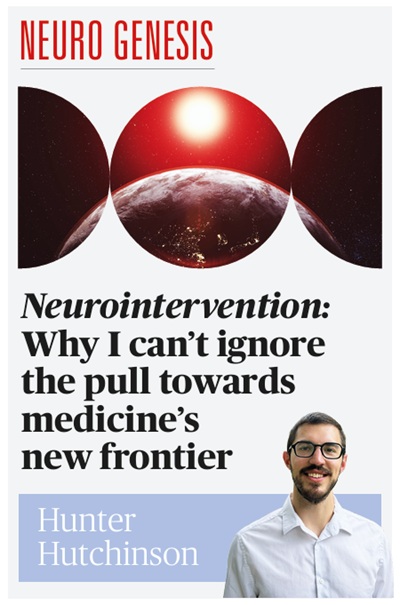
 As part of NeuroNews’s debuting Neuro Genesis column, MD/PhD student and aspiring neurointerventionist Hunter Hutchinson (Gainesville, USA) provides early perspectives on a field he finds himself increasingly drawn to.
Neurointerventional surgery is the future of care for patients with neurological diseases. As a physician-scientist in training, I can’t ignore the pull toward neurointervention. Every hour in the angiography suite, every Journal of NeuroInterventional Surgery paper and every conference draws me further in. Looking back on my path so far, I see three themes that define the field: leadership, innovation, and excellence. I have watched others embody them, and I work to do the same.
As a first-year medical student, I was fascinated by every corner of the neurosciences, from movement disorders to skull base to spinal cord injury. Then I watched my mentor, Brian Hoh (University of Florida, Gainesville, USA), perform a mechanical thrombectomy. He navigated smoothly from the access site to the M1 segment and achieved a thrombolysis in cerebral infarction (TICI) 3 reperfusion on the first pass, reversing a patient’s stroke in minutes.
What struck me the most was how the vasculature serves as a natural highway through the central nervous system. This highway has its own pathology to repair, from emboli that jam traffic to aneurysms that weaken the road. It also offers precise access for new therapies across the full range of neurologic diseases. To me, neurointerventional surgery is medicine’s new frontier. Its leaders bring calm to the chaos of emergencies like acute strokes, and they push the field forward through research on new drugs and devices that will help an even broader population of patients.
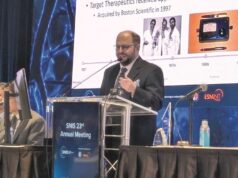
My first Society of NeuroInterventional Surgery (SNIS) conference in 2025 showed me how far innovation reaches in this field. I arrived expecting to learn more about aneurysms and subarachnoid haemorrhage—the focus of my PhD. I left thinking about diseases I had never connected to the angiography suite. I heard about intra-arterial lidocaine for migraines, super-selective intra-arterial chemotherapy, and endovascular brain-computer interface stents. I quickly realised that the field’s cutting edge reaches well beyond vascular disease. Together, these talks showed me that neurointerventionists can utilise the vascular highway used to treat strokes and aneurysms to deliver therapies to almost any part of the brain, and that this field is only beginning to explore the possibilities.
Beneath all this innovation and clinical leadership is a commitment to excellence. As an MD/ PhD student, I collect biospecimens from emergent thrombectomy cases, often at odd hours. Whether it’s 2pm or 2am, our attendings’ and fellows’ standards never change. My advice to other trainees is to get involved in neurointerventional research early and hold themselves to that same standard. Excellence does not go unnoticed, and this field rewards those who work hard and hold themselves to a high standard. I am excited for each step ahead, and I intend to carry leadership, innovation and excellence throughout my career.
Hunter Hutchinson is an MD/PhD student (GS1) at the University of Florida in Gainesville, USA.
The author declared no relevant disclosures.