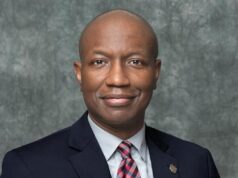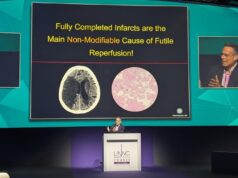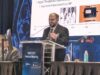
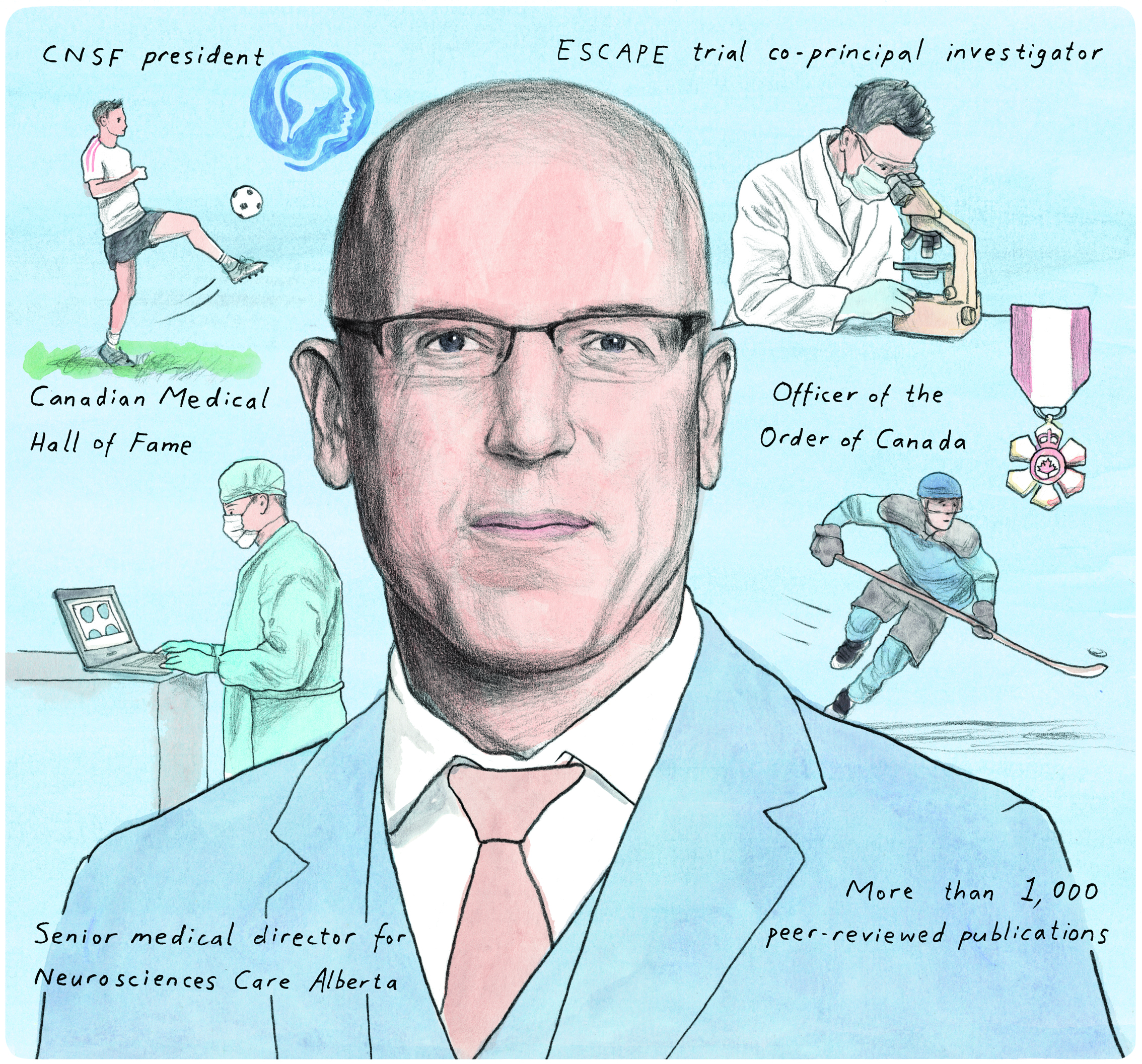
Following his recent induction into the Canadian Medical Hall of Fame—and at the end of his term as Canadian Neurological Sciences Federation (CNSF) president—neurology professor and pioneering stroke researcher Michael Hill (Calgary, Canada) speaks to NeuroNews to discuss the formative stages of his career, the landmark ESCAPE trial, the future of stroke care, and more.
Why were you drawn to a career in medicine?
The truth is that I was not drawn to medicine. I had no idea what that career might entail and I had no sense of what clinical medicine was—I was interested in research and science. I applied to medical school because I thought that the most interesting biochemistry, which I was studying at McGill University (Montreal, Canada), was going to be human biochemistry. I was accepted and ultimately deferred entry into medical school for a year so I could finish my undergraduate degree at McGill.
Who have your key mentors been and how have they impacted your career?
There are many from whom I learned and followed their example; most are now retired. Probably first, my father, Richard P Hill, who was a radiation physicist working in cancer research, instilled an interest in science and biology. In Ottawa, from Andreas Laupacis, I concluded that I necessarily should get formal training in clinical epidemiology; from Pierre Cardinal, I took a strong interest in critical care medicine; from Alan Guberman, and from Barry Guppy, who was my senior resident during my first neurology rotation, I got the bug for neuroscience. In Toronto, from Gyl Midroni, I learned the importance of meticulous work and critical relevance of measurement error in clinical decision-making. These mentors culminated in Calgary working with Alastair Buchan in stroke and Bill Ghali in epidemiology, from whom I learned too many things to count, and with whom it remains a great privilege to work. We completed the work necessary to obtain final regulatory approval for alteplase for stroke treatment in Canada. Finally, the team I work with now are colleagues, yes, but also mentors at many levels from whom I learn everyday—and it is only together that we have been able to impact stroke care.
What are your major goals as CNSF president?
I came to the role at a time of transition—although I did not know that initially—and stayed on to provide stability in that transition. Goals changed to stabilisation and renewal based upon a firm belief that the neuroscience community is stronger together, but the nature of the field requires specialisation. The CNSF has a renewed governance model with six active member societies, plans and hopes to expand, and a growing sense of vigour. A new president-elect is ready to take the reins in 2027, and I hope that the vision can continue to grow and expand. The community deserves a well-functioning active organisation to allow Canadian clinical neuroscience to fulfil its potential.
How would you assess the ESCAPE trial’s legacy roughly a decade on from its initial publication?
Mayank Goyal, Andrew Demchuk and I co-led the trial, and we were heavily invested in stroke imaging research and working collaboratively with Joseph Broderick, Thomas Tomsick, and the IMS III trial team. We designed ESCAPE to be fast, to select patients with proven occlusions and minimal change on non-contrast computed tomography (NCCT) imaging, and to maximise timely, complete reperfusion. We were able to convince colleagues at 22 sites and we were able cobble together funding. It was these collective features that led to such a dramatic result, which—published together with EXTEND-IA—both confirmed and extended the MR CLEAN trial results published a month earlier, and then was later reinforced further by the REVASCAT and SWIFT PRIME trials.
I think the reason ESCAPE was the only trial to confirm a mortality benefit was speed of treatment. I have no doubt that, overall, very fast endovascular therapy (EVT) does indeed save lives. The most gratifying part of the trial outcome was that it was an amazing example of very rapid translation to clinical routine care. The effect size from all the trials—summarised in the HERMES collaboration work—was so large that it demanded immediate implementation. The teams involved in the trial were able to instantly transition to routine provision of care because the trials tested a process of care. There were no regulatory barriers or delays in getting approvals. Further, the procedure was not just cost-effective, but cost-saving; it was financially worthwhile to do the procedure for hospitals and healthcare systems. On a personal note, from working on the stroke unit as an attending stroke neurologist, there was a visible and palpable change in the makeup of the inpatient census. Patients were going home in a few days and not being discharged to long-term care or skilled nursing facility, and that continues today.
Do you think neuroprotection has a significant role to play in the future of stroke care?
More broadly, it may be better to think that multiple interventions—perhaps timed—in the trajectory after stroke onset will be forthcoming. The initial idea on neuroprotection was always that it could span the gap in time between stroke onset and reperfusion. Blood is the best neuroprotectant. However, the rapidity and success of reperfusion treatments have made this a very difficult hill to climb. The niche areas where patients are treated and transported for EVT or ambulance-based delivery of such agents may yet be proven. The accumulated data suggest that, if neuroprotection is to work, as defined above, it must be delivered very quickly after stroke onset. Other interventions given later have been lumped under the rubric of ‘neuroprotection’. To some extent, this is semantics—interventions given after reperfusion treatments are the next frontier.
What is one thing within stroke medicine that is not being talked about enough?
Probably, measurement error on brain and neurovascular imaging. Too much of the time, we do not acknowledge in common language and discussions—in rounds, written papers and editorials, and presentations—that our imaging techniques have limits. This occurs among all specialities: neurology, neurosurgery, neuroradiology. The resulting assumptions become implicit, and lead to poor or at least incomplete clinical decision-making as errors of commission in our logic.
What excites you most about the field of neurology right now?
The amazing proliferation of novel treatments for both common and rare diseases suggests to me that we are at a new threshold in neurotherapeutics. Antisense oligonucleotides (ASOs) for spinal muscular atrophy (SMA), SOD1 amyotrophic lateral sclerosis (ALS), Machado-Joseph disease and others are immensely exciting. Immunotherapies for myasthenia gravis and novel beta-amyloid clearing agents for Alzheimer’s disease are the thin edge of the wedge on neurotherapeutics. Asundexian (Factor XIa inhibitor) is a milestone achievement—not just because it works and will be a new treatment for stroke prevention, but because it was tested in stroke first. New intravascular shunt devices for cerebrospinal fluid-to-petrosal sinus diversion will revolutionise the treatment of normal-pressure hydrocephalus (NPH) and idiopathic intracranial hypertension (IIH).
Overall, neuroscience is emerging into a new era of therapeutics and this is going to mean a strong demand for clinical practitioners in neurosciences—neurology, neurosurgery, and neurointervention. I foresee tremendous and ongoing growth in clinical neurosciences driven by the rapid development of neurotherapeutics. Finally, the intersection of the artificial intelligence (AI) revolution with neurology is full of promise and fraught with perils. We will need to get this right, and neuroscience must play a pivotal role in these debates.
What are your interests outside of stroke care?
Professionally, I have always been interested in the business of medicine and the structure of healthcare delivery. As I live in a country where much of care is centralised, my perspective is coloured by that experience and I have a central leadership role in my home province of Alberta. I have always played team sports, including varsity-level soccer as an undergraduate and, later, ‘old-man soccer’, as my kids called it. I have played hockey since I was five years old and, although a meniscal tear has stopped me playing soccer, I can skate without aggravating it, so I continue to play hockey—beer-league hockey, of course. I run for fitness and occasionally enter 5K or 10K races. My wife and I have a big garden, and we grow our own vegetables; last year, we grew enough potatoes to last us until about May! My two kids are grown up and pursuing their own careers, and, of course, I am substantially invested in helping them and in their success. Finally, I see my role now as focusing on really kickstarting, aiding and abetting the careers of up-and-coming clinician researchers—locally, nationally, and internationally.
FACT FILE
Current appointments:
- Senior medical director, Neurosciences Care Alberta, Acute Care Alberta
- Full professor, Department of Clinical Neurosciences, University of Calgary
- President, Canadian Neurological Sciences Federation
Education:
- 2003: MSc, clinical epidemiology, University of Calgary
- 1999: FRCPC, neurology, University of Toronto
- 1997: FRCPC, internal medicine, University of Ottawa
- 1993: MD, medicine, University of Ottawa
- 1989: BSc, biochemistry, McGill University
Honours (selected):
- 2026: Canadian Medical Hall of Fame
- 2024: Margolese National Brain Disorders Prize, University of British Columbia
- 2022: Officer of the Order of Canada
- 2021: Distinguished Scientist Award and Lecture, Canadian Society for Clinical Investigation (CSCI)
- 2017: Fellow, American Heart Association (AHA)
- 2016: Fellow, European Stroke Organisation (ESO)