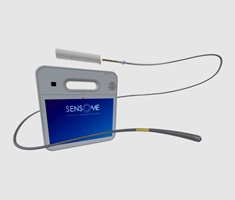
Sensome has announced the publication of first-in-human results from its CLOT OUT study demonstrating, “for the first time”, the ability to accurately characterise clot from inside a fully occluded brain vessel. Now published in the Journal of NeuroInterventional Surgery, the study shows that Sensome’s Clotild smart guidewire system can differentiate clot from surrounding tissue and reveal true clot boundaries during a mechanical thrombectomy. The system also met all primary endpoints in the study.
By integrating the “world’s smallest” electrical impedance sensor with predictive algorithms into a standard 0.014-inch guidewire, the Clotild clot-sensing guidewire is designed to provide physicians with real-time, in-situ biological intelligence about the occlusion. This new source of information aims to reduce guesswork during thrombectomy and support more informed treatment decisions, as per a Sensome press release.
In the CLOT OUT study, the Clotild guidewire successfully differentiated between blood, clot and arterial wall; identified the distal end of clots and thereby characterised clot length, with no use of contrast agent; and showed no vessel perforation, dissection or serious adverse events.
The authors conclude that, “to our knowledge, this is the first medical device able to provide in-situ clot characterisation with high precision”, adding that, “in the future, it may be considered to complement angiography, providing periprocedural insights to guide the treatment strategy in neurovascular interventions”.
CLOT OUT is described by Sensome as a first-in-human, international, multicentre, single-arm study of the Clotild smart guidewire system used in 41 acute ischaemic stroke patients at three centres in Australia and France.
“We know that factors such as clot length and platelet content affect outcomes, but we have only had an indistinct view from outside the body and have not had a way to accurately obtain this information,” commented Andrew Cheung (Liverpool Hospital, Liverpool, Australia), coordinating investigator of the CLOT OUT study and first author of the recent publication. “With continuous impedance measurements obtained during navigation with the smart guidewire, we were able, for the first time, to obtain detailed information from inside the occlusion itself and reconstruct the compositional scan of an in-situ clot in an occluded vessel in the brain. This new intelligence has the potential to improve outcomes at any centre conducting mechanical thrombectomy by simply replacing a conventional guidewire with a smart one.”
“We are excited that this study validates the unprecedented ability of our platform technology to lift the ‘information fog’ created by today’s imaging, and reveal the true makeup and position of an occlusion. By providing physicians with accurate biological intelligence for the first time, we intend to transform thrombectomy,” added Franz Bozsak, chief executive officer (CEO) and co-founder of Sensome. “Our broader vision is to combine the detailed clot and tissue information obtained from our smart wires with imaging and clinical data in one valuable database that provides AI [artificial intelligence]-fuelled insights to support physicians.”