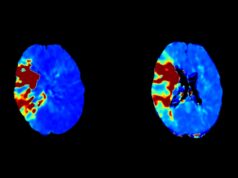
 Methinks today announced that its Methinks Ischemia product has received a CE mark. This module measures and visually highlights suspected ischaemic changes directly from a non-contrast computed tomography (NCCT) scan, without requiring CT angiography, CT perfusion (CTP), or magnetic resonance imaging (MRI).
“Receiving CE marking for Methinks Ischemia is an important milestone,” said Cristian Martí, founder of Methinks. “It brings ischaemic volume information, once reserved for perfusion imaging, to any hospital with a plain CT scanner to aid in the selection for endovascular thrombectomy and/or intravenous thrombolysis.”
Methinks Ischemia analyses non-contrast imaging showing suspicions of acute ischaemic infarct and estimates the ischaemic tissue visible on plain CT scans that are already taken in nearly every stroke workup.
Making this information available sooner can help physicians assess and select stroke patients for endovascular thrombectomy and/or intravenous thrombolysis as part of the broader clinical decision-making process, Methinks states in a press release. The company goes on to note that this is especially valuable in centres without CTP, where quantitative ischaemic tissue information might otherwise only become available after transfer to a thrombectomy-capable centre—or not at all. And, even where CTP is available, the product can deliver this information earlier than the CTP acquisition and processing pathway.
Methinks Ischemia runs alongside the company’s other CE-marked product modules—large vessel occlusion (LVO) and intracranial haemorrhage (ICH) detection on non-contrast CT, and LVO detection on contrast imaging—together enabling earlier transfer and treatment decisions.
In a peer-reviewed study conducted at the University of Iowa (Iowa City, USA), Methinks Ischemia demonstrated comparable performance to CTP in estimating ischaemic core volume in patients with suspected anterior-circulation stroke, with particularly strong performance beyond the six-hour window. This research was independently conducted and supported by an investigator-initiated grant.
“By measuring ischaemic volume directly from non-contrast CT, we can give physicians information to help them assess stroke patients quicker without contrast or advanced imaging. This will be critical in small hospitals without CT perfusion capabilities and, potentially, in helping to extend the time window for mechanical thrombectomy, which is exactly what we’re evaluating in the DONE SYMPLE trial,” commented Santiago Ortega-Gutierrez (University of Iowa, Iowa City, USA), global principal investigator of the DONE SYMPLE trial.