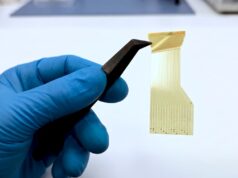
 Ability Neurotech has announced the first-in-human procedure for its brain-computer interface (BCI) technology. Conducted at the Department of Neurosurgery at the Technical University of Munich’s (TUM) University Hospital Rechts der Isar in Munich, Germany, the procedure marks the first real-world validation of Ability’s neural signal acquisition in a live surgical setting.
The study is being led by Arthur Wagner, Bernhard Meyer and Simon Jacob at the Department of Neurosurgery and Laboratory for Translational Neurotechnology in the TUM School of Medicine and Health. It will involve up to five individuals undergoing brain tumour surgery and, in addition, will capture neural data during 20–30 minutes of intraoperative recording for each patient.
Initial patients underwent end-to-end system validation and signal acquisition while under general anaesthetic. The next stages of the study will target neural decoding under similar surgical conditions, with conscious patients engaging in speech and motor tasks, as per an Ability press release.
“This procedure—recording neural data from humans for the first time—is a key milestone for Ability, and our mission to enable safe and ethical long-term BCI implantations,” said Rotem Kopel, chief executive officer (CEO) of Ability. “The real-world validation of our signal acquisition system to capture high-quality neural data in patients brings us another step closer to restoring communication, movement and autonomy for those living with paralysis and speech loss.”
Ability claims it is setting a “new standard” for safe and ethical neural interface technology with validated human data. The company’s fully implantable BCI is designed to capture raw, high-resolution brain signals and transmit massive amounts of lossless data at significantly higher bandwidth compared to standard Bluetooth-based systems. Its minimally invasive and patient-centric design is engineered for long-term implantation while maintaining high-fidelity neural data capture, the release adds.
“This research allows us to capture known neural phenomena, including evoked potentials and high-gamma activity, and benchmark Ability’s signal quality against established clinical electrophysiology systems,” commented study co-lead Jacob. “Establishing this scientific basis is what will allow BCI technology to mature responsibly from research into a reliable clinical tool.”
According to the company, this project marks Ability’s entry into the clinical stage—and the successful generation of its first human neural dataset in this early feasibility testing will be followed by a first long-term implantation study.