 Research has revealed that rates of brain aneurysm treatment in Lithuania have climbed steadily since 2019, with public awareness of the condition growing substantially over the past few years as well. However, annual surveys commissioned by the Lithuanian Brain Aneurysm Foundation also suggest a “critically important” lack of knowledge on risk factors of the condition within the country’s population.
Findings collected by Lithuania’s Institute of Hygiene (HI) and shared with NeuroNews by the non-profit Brain Aneurysm Foundation show that, in 2019, around 150 neuroendovascular procedures were conducted to treat cerebral aneurysms or arteriovenous malformations (AVMs), and the number of brain aneurysms treated via surgical clipping was only marginally higher. However, by 2024, these figures had risen to more than 220 for endovascular treatments and just over 250 for surgical clipping. These data were pooled from the five hospitals across Lithuania that provide surgical and endovascular treatments for brain aneurysms.
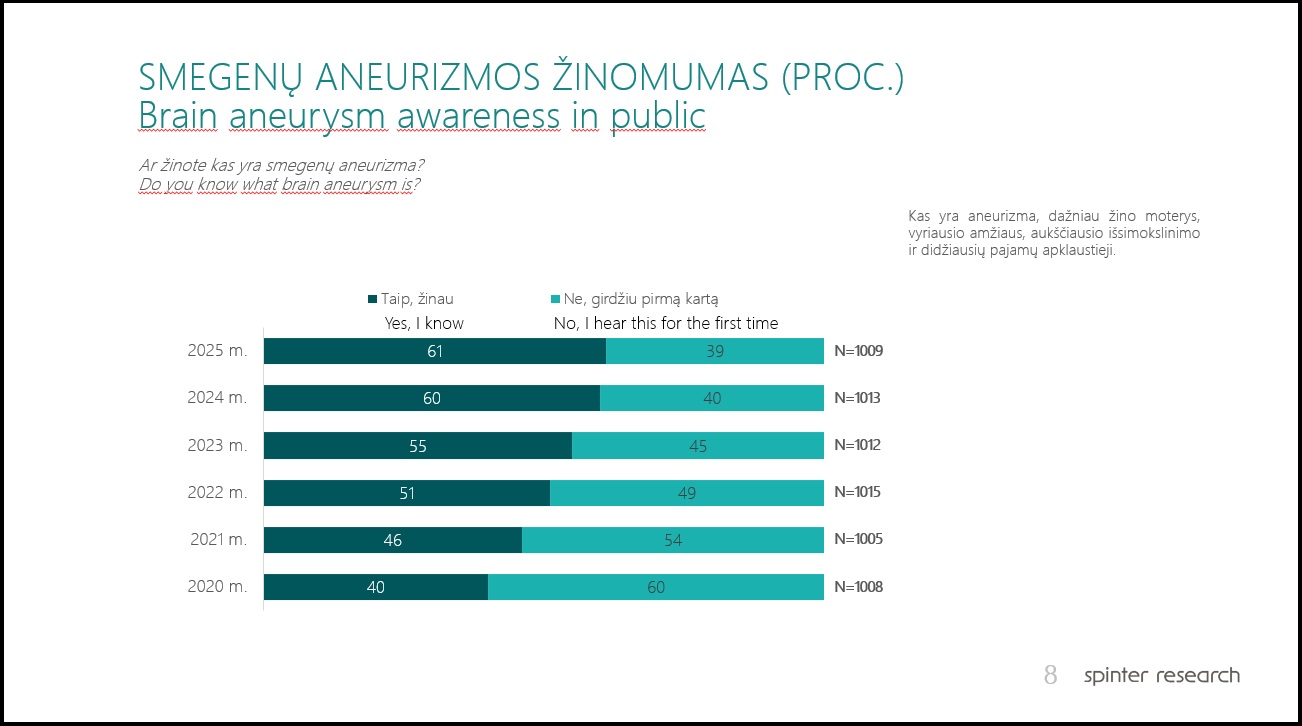
This steady growth in brain aneurysm procedures is matched by an increase in the Lithuanian population’s broad awareness of the condition. A representative public survey conducted in the summer of 2025 by Spinter Research revealed that—across more than 1,000 adult respondents—61% of people said they knew what a brain aneurysm was. This compares favourably to survey data from 2020, which found that just 40% of 1,008 respondents knew what a brain aneurysm was.
“On the one hand, the survey results show that consistent communication about this disease has produced results—61% of Lithuanians know what a brain aneurysm is,” said Evelina Krasauskienė, director of the Brain Aneurysm Foundation, highlighting the potential impact of the organisation’s advocacy efforts over the past few years. “That’s a 21-point increase compared to 2020, when we conducted the first such survey and only 40% of Lithuanians had heard of it.
“On the other hand, half of those who have heard of brain aneurysms are unaware of the risk factors that increase the likelihood of developing them; 35% say they have heard of such factors but are not certain, and only 14% can name at least a few [factors] that raise the risk of aneurysm formation and rupture. This lack of knowledge is critically important, as people in risk groups should undergo preventive screening to avoid ruptures.”
 The survey also indicated that, as of 2025, some 26% of respondents did not know how brain aneurysms are diagnosed. While 38% and 35% of respondents mentioned magnetic resonance imaging (MRI) and computed tomography (CT) scans, respectively, Lithuania’s Brain Aneurysm Foundation comments that “it is important to stress that a standard CT scan is not suitable for diagnosing brain aneurysms”, with adequate diagnoses requiring either an MRI or CT angiography (CTA).
Also revealed by the 2025 survey data was the fact that 92% of respondents had never been advised by their family doctor to check for a brain aneurysm, and only 10% had undergone health checks for the condition. The majority—some 60%—said they trust that their family doctor would recognise the risk of a brain aneurysm and refer them for further tests. According to the Lithuanian Brain Aneurysm Foundation, this trust “creates both responsibility and opportunity”.
“Family doctors play a critical role as a ‘filter’, helping to identify people in risk groups—for example, those with high blood pressure or genetic predispositions,” Krasauskienė added. “In such cases, the family doctor can refer the patient to a neurologist, who can then determine whether further tests, such as an MRI, are needed.”
The foundation also emphasises that, if an aneurysm is detected and treatment is being considered, it is “crucial” for patients to consult an interventional radiologist to evaluate the possibility of embolisation—an endovascular procedure that has become more common in recent years and is now considered a standard-of-care approach alongside clipping via open surgery. As per the 2025 survey, around 40% of people in Lithuania who know about brain aneurysms are unaware of these two interventional treatment methods.
According to Krasauskienė, patients diagnosed with brain aneurysms “should always seek two opinions”—from a neurosurgeon and from an interventional radiologist—before making a decision about their treatment. She stated that this can help patients to make an informed choice and select the most suitable treatment method, adding that a lack of information often deters people from interventions that could prevent subsequent aneurysm ruptures.
The Lithuanian Brain Aneurysm Foundation recently highlighted the story of a 44-year-old patient named Monika who underwent a successful embolisation to treat her unruptured cerebral aneurysm in 2024. Audrius Širvinskas (Republican Vilnius University Hospital, Vilnius, Lithuania)—the interventional radiologist who performed this procedure—emphasised the potentially lifesaving importance of early detection and timely diagnosis.
“A brain aneurysm is often silent; a person may have it for years without knowing,” he commented. “But, if it ruptures, the consequences can be tragic. Half of [all] cases end in death and many others in lifelong disability. Monika’s case is an excellent example of how an aneurysm—discovered accidentally and still small—can be treated safely and effectively. The smaller [but already beyond the risk threshold] the aneurysm, the safer the intervention. Additionally, modern embolisation techniques allow patients to avoid open surgery and return quickly to their normal lives.”