
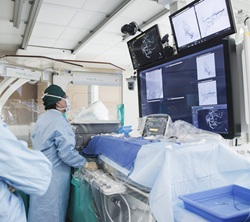
Cathpax, a spinoff of nuclear radiation protection group Lemer Pax, announced today the commercial launch of its Nova-X radiation protection system in Europe and the Middle East. The company says it has already signed several distribution contracts and, over the past few months, has installed its product in different centres across strategic geographic regions—demonstrating a “keen interest” in this new solution.
Additionally, Cathpax notes in today’s press release that these efforts were buoyed by “excellent clinical results” highlighting Nova-X’s “unparalleled radiation protection performance”, against a current backdrop that favours the implementation of team-wide, full-body radiation protection equipment over conventional personal protection equipment that only provides partial protection—as per the new ‘As Low and As Light as Reasonably Achievable’ (ALARA+) standard.
Earlier this year, results from NOVARAD—a multicentre, two-arm, prospective clinical study assessing the effectiveness of Nova-X—were presented at the ABC Win Seminar (18–23 January, Val d’Isère, France). NOVARAD, which is described by Cathpax as the world’s first study aimed at evaluating exposure to X-rays in interventional neuroradiology, saw Nova-X produce “unique results” when compared to competing or conventional systems on the market.
Based on an “unmatched level” of radiation protection, these results open the door to a new way of working for operators, allowing them to dispense with wearing lead aprons, the company further claims, also noting that—by improving radiation protection for cath lab staff—the Nova-X system can replace the conventional full-body and individual protection systems that are “ineffective” in protecting practitioners from radiation-induced pathologies.
Cathpax states that, as such, it has received several expressions of interest over the course of just a few months. To date, distribution contracts have been signed in multiple geographic regions, including Poland with Model Medical, and the DACH region—Germany, Austria and Switzerland—with MedUnity. Several systems were also delivered before this announcement to centres including Bonn University Hospital (Bonn, Germany) and Hospital de Santo António (Porto, Portugal).
According to Cathpax, healthcare professionals at some equipped centres are already operating without lead aprons following authorisation from their occupational medicine departments, reporting that this has given them the capacity to refocus fully on medical procedures with a significant reduction in fatigue and stress.
By the end of 2027, Cathpax intends to have a total of 50 systems installed in the Europe, Middle East and Africa (EMEA) region.
“The NOVARAD clinical study has shown the full potential of our new radiation protection system, boasting a performance currently without equivalent on the market,” said Cathpax president Pierre-Marie Lemer. “A procedure using Nova-X is equivalent to the general public’s exposure to natural radioactivity for approximately eight hours, or a third of a passenger’s exposure on a flight from London to Paris. This product reflects our extensive know-how and expertise in the design and production of innovative radioactive protection technologies and equipment. I am extremely proud of the many benefits it brings to interventional physicians and, indirectly, to patients.”
“Since presenting our clinical results, we have received many expressions of interest, and initial feedback has been extremely positive,” added Cathpax chief executive officer (CEO) Valérie Chevreul. “In a global market with tens of thousands of cath labs performing 40 million procedures a year, our potential for growth is enormous. Our first focus is the European market, and we will look at the US and Asian markets towards the end of 2027.”
Cathpax also notes that its Nova-X system will be showcased at next week’s LINNC Paris course (1–3 June, Paris, France)—via product demonstrations at the company’s booth, and also as part of multiple planned live cases.