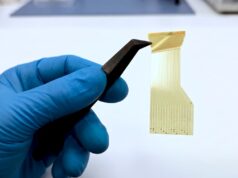
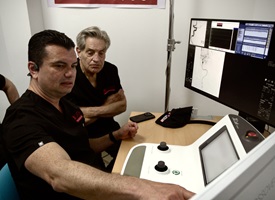
XCath has announced the successful completion of the “world’s first” telerobotic stroke procedure as part of a clinical investigation dubbed ‘Operation Robo Angel’. This landmark remote mechanical thrombectomy was performed by neurointerventionist Vitor Pereira (University of Toronto, Toronto, Canada) using the company’s Iris surgical robotic system. Pereira led the procedure from Clinica Norte in Santiago, Panama—more than 200km away from the patient, who was located in Panama City.
Local neurosurgeon Anastasio Ameijeiras Sibauste (The Panama Clinic, Panama City, Panama) and robotic technologist Nicole Cancelliere (Unity Health, Toronto, Canada) were with the patient during the thrombectomy, as reported in a press release from XCath.
“Panama is honoured to be the birthplace of a medical breakthrough that will save countless lives around the world,” said Panama’s president, José Raúl Mulino. “XCath’s Operation Robo Angel demonstrates the extraordinary potential that emerges when visionary leadership meets the dedication of our physicians and institutions. This historic achievement reflects the spirit of Panamanian collaboration and our nation’s commitment to advancing healthcare for humanity. On behalf of the people of Panama, we proudly celebrate this milestone, and the global hope it represents for patients and families affected by stroke.”
XCath’s press release goes on to detail that, during the procedure, the Iris system demonstrated precision in navigating and delivering therapeutic devices over a long-distance connection with “no perceptible latency”.
“Mechanical thrombectomy is proven to reduce mortality and disability in patients with ischaemic stroke but, unfortunately, access to the procedure is extremely low,” Pereira stated. “The work XCath has done with the Iris system is a giant step toward broadening access to mechanical thrombectomy for patients around the world. The experience of performing the first-in-human procedure matched the successful simulated procedures we previously performed with the team, with imperceptibly low latency and no disruptions to the surgical workflow. It is the highlight of my career to be involved in this historic achievement.”
Providing further details on this breakthrough case, XCath’s release notes that a male patient in his late 60s presenting with acute stroke symptoms initially arrived at a referring hospital, where diagnostic imaging confirmed a large vessel occlusion (LVO) in the M1 segment of his left-sided middle cerebral artery (MCA). The patient was rapidly transferred to a primary treatment centre—The Panama Clinic—where he was adjudged to have a National Institutes of Health stroke scale (NIHSS) score of 21, representing a severe stroke requiring rapid intervention.
Upon arrival, the patient was immediately taken to the operating suite for telerobotic endovascular treatment. The total amount of time it took to transfer him between sites was approximately 15 minutes, according to XCath. During transportation, the onsite clinical team prepared the procedure room with the Iris system, and established connectivity with the remote clinical team and remote operator.
Using the Iris system, the remote operator robotically navigated therapeutic devices through the patient’s intracranial vasculature to the occlusion site. Mechanical thrombectomy was performed via a combined technique utilising a stent retriever and balloon occlusion with dual aspiration. The clot was successfully removed at the first attempt, and the patient achieved complete reperfusion of the affected vessel with a modified thrombolysis in cerebral infarction (mTICI) score of 3 at the conclusion of the procedure. The patient was evaluated after the procedure, and showed improvement in both general condition and neurological functions. At 24 hours, the patient continued to progress, demonstrating an NIHSS score of 2, and is expected to make a complete recovery.
“The world’s first telerobotic neurosurgery was made possible by an exceptional team working alongside more than 60 physicians across five hospitals, all united around a single priority: patients,” said XCath chief executive officer (CEO) Eduardo Fonseca. “The true legacy of this moment will be measured in the millions of lives that could be saved each year as stroke treatment reaches patients who, today, have no access to it.”
“XCath has accomplished what no other company has achieved in stroke care: a successful remote robotic mechanical thrombectomy delivering lifesaving treatment to a patient that would have otherwise not been able to receive treatment,” added XCath chairman Fred Moll. “It was a privilege to be present in this historic moment. I believe that the XCath system will help create a new standard of care for stroke patients around the world.”