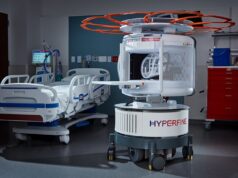
 Hyperfine has announced that it has completed enrolment in the Contrast PMR study—a prospective, multicentre clinical study designed to evaluate the feasibility and visualisation benefits of contrast-enhanced ultra-low-field portable magnetic resonance imaging (MRI) using the company’s Swoop system. The study is intended to support the first expansion of the Swoop system’s indications for use since its original US Food and Drug Administration (FDA) clearance, and represents an important step toward broadening the clinical utility of portable MRI, according to Hyperfine.
Contrast-enhanced MRIs represent a meaningful portion of brain MRI examinations performed today, and they play a critical role in the evaluation of brain tumours, inflammatory disorders, and other conditions associated with blood-brain barrier disruption, the company also states.
As such, the primary objective of the Contrast PMR study is to evaluate the visualisation of brain lesions—including those associated with blood-brain barrier disruption—using contrast agents with ultra-low-field portable MRI. Visualisation is assessed across three endpoints related to lesion appearance, with the study specifically evaluating the Swoop system’s ability to visualise common contrast-enhancing brain lesions using routinely administered gadolinium-based contrast agents.
“The completion of enrolment of the Contrast PMR study is an important milestone in expanding the use of portable MRI across clinically relevant imaging modalities across a broader range of neurological applications,” said W Taylor Kimberly (Mass General Brigham, Boston, USA). “Contrast-enhanced imaging is fundamental to the evaluation of many brain lesions, including tumours and other conditions associated with blood-brain barrier disruption. This study is designed to assess whether portable MRI can provide meaningful visualisation of the types of lesions neurologists and neurosurgeons routinely evaluate using contrast-enhanced MRI. If successful, contrast-enhanced portable MRI could meaningfully expand the role of point-of-care imaging across a wide range of clinical settings.”
“We believe contrast-enhanced imaging can be a powerful catalyst for expanding adoption of the Swoop system and extending its value across the diverse care settings we serve,” added Maria Sainz, president and chief executive officer (CEO) of Hyperfine. “In addition to supporting critical diagnostic and treatment decisions across a broad range of clinical settings, contrast-enhanced brain imaging benefits from established, dedicated reimbursement pathways, creating a strong foundation for adoption and long-term value for providers. We see this unlocking expanded use in outpatient settings and opening new applications for post-procedural imaging in surgical environments, including assessment of residual tumour after resection.”
Following completion of enrolment, Hyperfine will proceed with image review, data analysis, and preparation of a planned US FDA 510(k) submission, which the company intends to submit by the end of 2026. Hyperfine also notes, however, that expanded use of the Swoop system with contrast agents currently remains subject to US FDA clearance.