This advertorial is sponsored by Siemens Healthineers.
 A portable head computed tomography (CT) imaging system—SOMATOM On.site (Siemens Healthineers)—can help hospitals transform their critical care workflows. By bringing head CT scans directly to patients’ bedsides in the intensive care unit (ICU), it has the potential to save time and may help reduce transport-related risks.1,2
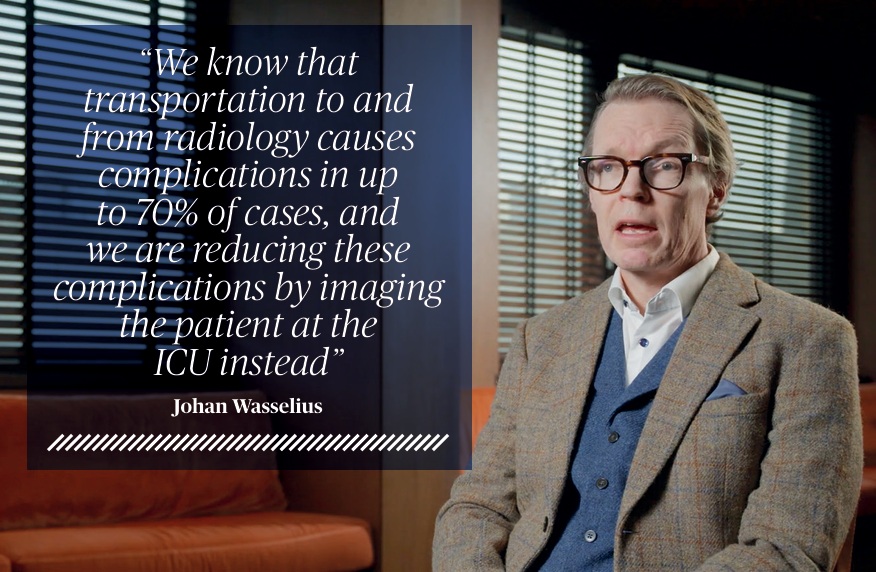
“The SOMATOM On.Site allows us to scan patients with excellent image quality at point of care in the ICU where they are located, which carries several advantages,” said Johan Wasselius (Skåne University Hospital, Lund, Sweden), whose centre has adopted this innovative technology. “We know that transportation to and from radiology causes complications in up to 70% of cases, and we are reducing these complications by imaging the patient at the ICU instead. We’re also reducing the time for the ICU staff to take the patient to and from radiology.”
Clinical research has established that time is of the essence when it comes to critical head conditions, with these patients needing constant supervision owing to risks of sudden health status deterioration, which, in turn, requires rapid additional evaluation. Transportation also increases adverse event risks for roughly one in four patients, as existing health conditions may be exacerbated due to the delicate nature of these ICU cases.2
SOMATOM On.site has been designed to circumvent these issues, enabling a more stream lined and ultimately faster critical care workflow.1 After the treating physician has ordered a CT scan and the technologist has been informed, the portable system can be easily manoeuvred to the patient’s bedside to perform the scan.1 From there, the only remaining step is for these results to be automatically sent to the archiving system for review by radiologists, at which point diagnosis and treatment can begin based on the findings. This process removes multiple steps from traditional hospital workflows, reducing standard total workflow times from 50 minutes down to 20 minutes, on average.
In addition to time-saving capabilities and the ability to reduce transportation burden, portable head CT scanners can carry notable benefits for healthcare staff across the entire critical care workflow as well.1,3
Patients with acute and critical conditions tie up stationary CT scanners in the radiology department for at least twice as long as compared to non-acute or non-critical patients—meaning the availability of a portable CT scanner allows technologists to utilise their time more effectively.4 The same can be said for ICU nurses. By requiring—dependant to local regulations—at least two accompanying nurses, critical care transportation takes time and resources away from the ICU. It is also estimated that a shortage of 13 million nursing staff in the future will result in significantly overburdened personnel.3 Scanning patients in their hospital beds, however, means ICU nurses can focus on their core tasks without leaving the unit, thus supporting continuous patient care.
Additionally, unscheduled interruptions within the radiology department can be reduced with the availability of an extra portable scanner dedicated to critical care patients, enabling a more streamlined utilisation of the stationary fleet.
SOMATOM On.site brings with it several features intended to help physicians achieve fast and reliable answers while managing their critical care patients. Among these is a “first-of its-kind” telescopic gantry design that allows easy patient positioning, minimises motion arti facts, and protects staff as well as neighbouring patients from scatter radiation during scanning. SOMATOM On.site also has a self-shielding radiation system that has been built with the safety of staff and neighbouring patients in mind, protecting them from scatter radiation—one of the main challenges associated with portable scanning.
Furthermore, regarding driveability, the system can be manoeuvred through hospitals seamlessly thanks to its two driving speeds, front-facing camera, brake, and ergonomic handle. Further integrated accessories support physicians to position patients for consistent scan results, while SOMATOM technologies ensure that sharp, high-quality images can be obtained reliably.
Lastly, SOMATOM On.site comes equipped with Siemens Healthineers’s myExam Companion, which is an intelligent software designed to work with the user to achieve optimal scan results, as well as myExam Cockpit, which helps users to standardise the protocols they use, and myExam Compass, which provides additional guidance during the examination.
Siemens Healthineers establishes a “new standard” in head CT imaging with SOMATOM On.site, highlighting intraventricular cerebral bleeding, follow-up brain tumour detection, head CT angiography and post-surgical follow-up as key examples of cases in which it provides an effective solution.
“We see several benefits of point-of-care CT imaging,” Wasselius commented. “And, now, with a scanner that can provide image quality that is actually superior to stationary scanners, we really don’t see any reason why—if possible—patients should not be scanned at the ICU.”
References:
- Rumboldt Z, Huda W, All J W. Review of portable CT with assessment of a dedicated head CT scanner. Am J Neuroradiol. 2009; 30(9): 1630–6.
- Parmentier-Decrucq E, Poissy J, Favory R et al. Adverse events during intrahospital transport of critically ill patients: incidence and risk factors. Ann Intensive Care. 2013; 3(1): 10.
- International Council of Nurses. ICN Policy Brief – The global nursing shortage and nurse retention [Internet]. International Council of Nurses. 2021 [cited 2026 Aug 28]. Available from: icn.ch/node/1297.
- Data on file.
For more information on SOMATOM On.site, visit Benefits of portable head CT imaging – Siemens Healthineers.
The products/features (mentioned herein) are not commercially available in all countries. Their future availability cannot be guaranteed.
The statements by customers of Siemens Healthineers described herein are based on results that were achieved in the customer’s unique setting. Because there is no “typical” hospital and any variables exist (e.g., hospital size, case mix, level of IT and/or automation adoption) there can be no guarantee that other customers will achieve the same results.