Arissa Medical has announced the completion of 12-month digital subtraction angiography (DSA) follow-up for all 16 patients enrolled in its prospective pilot clinical study of the Syntra intrasaccular device.
The 12-month results demonstrated a 100% rate of technical success as well as a 93.75% rate of adequate aneurysm occlusion, with 15 of 16 patients achieving Raymond-Roy Class I–II. Additionally, there were zero retreatments, zero device- or procedure-related serious adverse events, and zero instances of device migration. No parent-vessel stenosis, thrombosis or compromise were identified on 12-month follow-up imaging. Furthermore, all 16 patients achieved 12-month modified Rankin scale (mRS) and National Institutes of Health stroke scale (NIHSS) scores of zero.
Angiographic outcomes in the pilot study were evaluated through independent review with blinded core laboratory assessment. The study was conducted at Instituto de Neurocirugía Dr Alfonso Asenjo in Santiago, Chile under the direction of principal investigator Juan Gabriel Sordo.
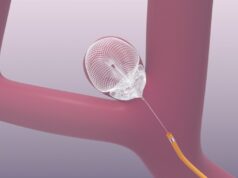
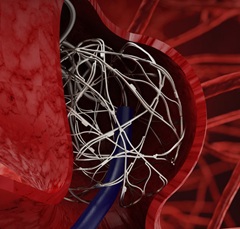
“Our objective with Syntra is to give physicians another tool for aneurysms in which conventional coiling can be technically challenging,” commented Sordo. “The ability to position the device completely within the aneurysm while providing support for coil embolisation offers an interesting intrasaccular treatment strategy for selected complex anatomies. Furthermore, the Syntra intrasaccular device was designed to assist in the treatment of terminal and lateral brain aneurysms with a wide neck, acting as a scaffold that allows the subsequent placement of detachable coils inside the dilation without risk of their migration to the lumen of the carrier vessel. This feature makes Syntra replace the need to place assistive devices in the carrier artery, such as stents and eCLIPs [Evasc Neurovascular], allowing to increase the intra-aneurysmal packing density, improving rates of complete occlusions.”
The Syntra intrasaccular device is designed to provide an entirely intrasaccular treatment platform, positioning the device within the aneurysm sac rather than as a permanent implant across the parent artery, as stated by Arissa. The device is intended to provide support at the aneurysm neck and facilitate coil embolisation in selected complex aneurysm anatomies.
The present pilot study targeted complex, wide-neck, irregular sidewall and bifurcation aneurysms, including anatomies characterised by challenging angulation relative to the parent vessel.
According to Arissa, the researchers for the study—which remains ongoing—consider Syntra to be a user-friendly device and, as it is available in a range of appropriate sizes, believe it will allow the treatment of aneurysms ranging from around 4mm to 15mm in diameter, simplifying their embolisation without a subsequent requirement of antiplatelet medication for prolonged periods due to assistive intra-arterial devices.
Arissa now intends to continue clinical and development activities to further characterise the safety, performance and angiographic durability of its Syntra technology. The present pilot study was a prospective, single-arm, non-randomised clinical evaluation of the device in patients with complex wide-neck intracranial aneurysms. Post-pilot study closure proceedings, the company will seek US Food and Drug Administration (FDA) Breakthrough Device designation for the treatment of broad-neck cerebral aneurysm indications.
“The completion of 12-month DSA follow-up across the entire 16-patient cohort represents an important milestone for Arissa Medical and the Syntra programme,” said Byung Ju, chief executive officer (CEO) of Arissa. “The results provide encouraging clinical evidence supporting the continued development of an entirely intrasaccular approach for challenging intracranial aneurysms. Importantly, we observed durable angiographic outcomes at 12 months without retreatment or device-related serious adverse events in this initial cohort.”