Kandu has announced the publication in Stroke: Vascular and Interventional Neurology of BCI-REHAB—a US National Institutes of Health (NIH)-sponsored randomised controlled trial of the company’s at-home, non-invasive brain-computer interface (BCI) therapy for chronic stroke.
The findings—first shared via an oral presentation at the 2026 International Stroke Conference (ISC; 4–6 February, New Orleans, USA)—show that patients using the US Food and Drug Administration (FDA)-cleared IpsiHand system achieved significantly greater improvement in upper-extremity motor function than those following a standard home exercise programme.
“This is the first randomised trial to show that engaging preserved ipsilateral neural signals through a non-invasive BCI can drive clinically meaningful motor recovery in chronic stroke,” said Eric Leuthardt, chief scientific officer of Kandu and principal investigator of the study. “With this additional evidence, patients and their families—who were told years ago that chronic stroke recovery was unlikely—now have further evidence that says otherwise.”
The recently published trial compared at-home BCI-enabled therapy using IpsiHand with a conventional at-home exercise programme. Participants were at least six months post-stroke with persistent upper-extremity weakness and were directed to complete their assigned therapy for one hour per day, five times per week over 12 weeks, with no in-clinic appointments in the ensuing period.
The enrolled participants represented a broad population spanning severe, moderate and mild deficits, ages of 19 to 82 years, and 0.5 to 30.1 years since stroke onset. The trial was stopped early for efficacy, and 62 participants—with a mean time since their stroke of 5.4 years—were included in the primary analysis. Thirty-seven of these patients were in the BCI therapy group compared to 25 in the control group.
Patients treated with BCI therapy showed a six-point overall gain in upper-extremity Fugl-Meyer (UEFM) scores, exceeding the established minimal clinically important difference (MCID) of 5.25 for chronic stroke survivors. Additionally, BCI patients demonstrated a 4.5-point greater improvement in UEFM scores compared to the control arm.
In addition to finding no serious or device-related adverse events within the BCI group, the study revealed a number needed to treat of just 2.2 in order for one patient to make clinically meaningful gains, with 55.5% of IpsiHand patients achieving an MCID in 12 weeks compared to 9.6% in the control arm—an absolute difference in response of 45.8%.
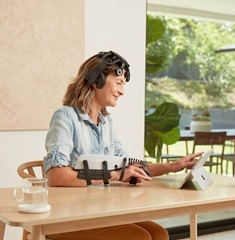
A Kandu press release details that IpsiHand pairs a non-invasive electroencephalogram (EEG) headset with a wearable handpiece that assists the motion to open and close the hand—and, when the system detects the patient’s intention to move the impaired hand, the handpiece opens and closes it in near real time, reinforcing the neural pathways that drive recovery.
“Publication in this prestigious journal is exactly the kind of evidence that changes how a therapy is viewed and adopted,” commented Leo Petrossian, chief executive officer (CEO) of Kandu. “This most recent published clinical study adds to the already large body of evidence supporting the therapeutic benefit of IpsiHand as we build a new standard of care in non-invasive chronic stroke recovery.”
The authors note that, because the trial measured outcomes over 12 weeks, it may not capture the full potential of longer-term use—and, according to Kandu’s release, recently published real-world evidence suggests continued improvement beyond that window.