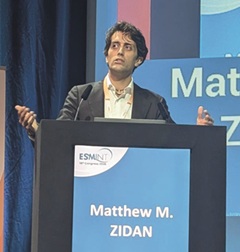
“Protecting the foetus begins with protecting the mother,” was the concluding message delivered by Matthew Zidan (Bonn University Hospital, Bonn, Germany) based on late-breaking findings from the MATERNA-X study presented at the 2026 European Society of Minimally Invasive Neurological Therapy (ESMINT) congress (2–4 September, Marseille, France).
The study used a ‘fake’ pregnant woman’s belly filled with different amounts of water to simulate amniotic fluid in order to compare theoretical radiation dosage to a foetus—with versus without the Nova-X system (Cathpax)—during the three trimesters of pregnancy.
Its results indicated radiation dosage reductions of 49%, 35% and 57% during the first, second and third trimesters, respectively. Zidan noted that the foetus therefore appears to benefit from their mother’s full-body protection, even during the period before the pregnancy is known about, which underscores the value of a shielding system that is used routinely as opposed to relying on individual adjustments over time.
Zidan went on to conclude that full-body shielding seems to be provided—regardless of abdominal circumference—during the later trimesters, with preliminary data indicating that the additional hourly dose to the foetus with Nova-X appeared to be comparable to environmental background radiation (0.1μSv) through each of the three trimesters.
“As a mother of two, I know very well the concerns women have when working in the angio suite during pregnancy,” commented Franziska Dorn (Bonn University Hospital, Bonn, Germany), congress chair for ESMINT 2026. “The MATERNA-X study addresses a topic that is highly relevant for our field: concerns about radiation during pregnancy remain a real barrier for women considering a career in neurointervention. Our key message is that a full-body shielding system can protect the unborn child from the very first weeks, often before a pregnancy has been disclosed. If we can bring foetal exposure close to background levels, we remove one of the reasons talented women leave or avoid our specialty.”