Findings from the MILD-MT randomised controlled trial (RCT) have shown mechanical thrombectomy to be safe and effective in ischaemic stroke patients with National Institutes of Health stroke scale (NIHSS) scores of less than six, potentially providing evidence for the expansion of thrombectomy treatments into this more mildly symptomatic population.
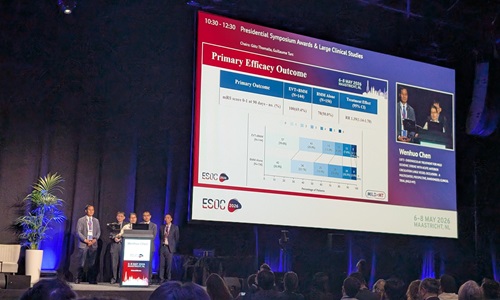
These late-breaking data were presented by Wenhuo Chen (Fujian Medical University Union Hospital, Fuzhou, China) and Tingyu Yi (Zhangzhou Municipal Hospital, Zhangzhou, China) alongside other MILD-MT investigators at the 2026 European Stroke Organisation Conference (ESOC; 6–8 May, Maastricht, Netherlands).
The presenters noted initially that, while thrombectomy has been deemed safe and effective across a number of global RCTs, subsequently becoming a standard-of-care approach, the majority of studies to date have restricted inclusion to stroke patients with NIHSS scores ≥6.
In an attempt to fill this gap in existing evidence, the MILD-MT investigators enrolled 304 anterior-circulation large vessel occlusion (LVO) patients with NIHSS scores <6 at 26 centres across China, randomising them 1:1 to receive either thrombectomy plus best medical management or best medical management only. Patients needed to have presented within 24 hours of symptom onset as well as having core infarcts ≤50mL and mismatch volumes ≥50mL on perfusion imaging. Analyses of the study population’s baseline characteristics revealed a median NIHSS score of 4 and a predominance of intracranial atherosclerotic disease (ICAD)-related strokes.
The trial’s primary endpoint was the rate of 90-day excellent functional outcomes (modified Rankin scale [mRS] 0–1) between the two groups, with this endpoint being achieved at a rate of 69.4% in the thrombectomy arm versus 50% in the medical management arm, translating into a risk ratio of 1.39 (95% confidence interval [CI], 1.14–1.7). Additionally, as per secondary efficacy endpoints, rates of mRS 0–2 at 90 days were 82.6% with thrombectomy versus 66% without (risk ratio, 1.28), while 90-day Barthel Index scores of 95–100 were observed at rates of 83.9% versus 69.9%, respectively (risk ratio, 1.23).
Analyses of MILD-MT’s key safety endpoints also revealed positive signals, with the rate of symptomatic intracranial haemorrhage (ICH) within 48 hours being comparable between the two groups (risk ratio, 1.49). All-cause mortality rates were also similar, at 0.7% in the thrombectomy arm and 0% in the medical management arm. Furthermore, early neurological deterioration (END) occurred at a lower rate with thrombectomy versus without—a trend observed at both 24 hours (6.3% vs 10.9%, respectively; risk ratio, 0.65) and seven days (13.9% vs 31.4%, respectively; risk ratio, 0.48).
These efficacy and safety outcomes were also found to be consistent across a range of prespecified patient subgroups.
The presenters concluded by noting that MILD-MT represents the first completed RCT evaluating thrombectomy in a population with mild anterior-circulation LVO strokes, and therefore provides randomised evidence supporting its use in these patients. Offering potential explanations for the strong performance of thrombectomy in this trial, they highlighted the fact that perfusion imaging was able to successfully identify patients at high risk of END, alongside a 94% rate of recanalisation being achieved across high-volume centres.