This advertorial is sponsored by Vesalio.
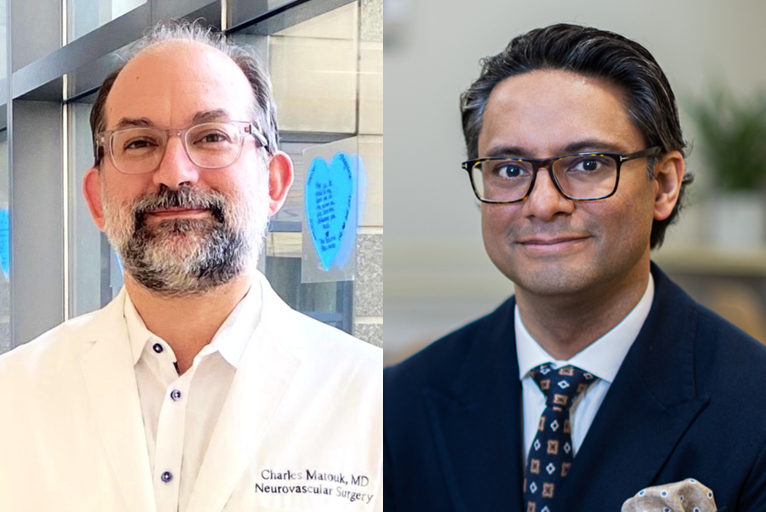
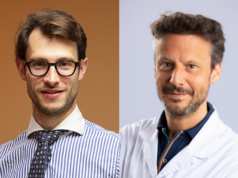
As interest in optimal strategies for treating post-aneurysmal subarachnoid haemorrhage (aSAH) cerebral vasospasm continues to grow, two physicians helping to drive innovation and clinical research on vasospasm management—Charles Matouk (Yale New Haven Hospital, New Haven, USA) and Paul Bhogal (Royal London Hospital, London, UK)—discuss this evolving landscape.
“In aSAH patients who reach the hospital, the number one reason for not making it out of the hospital unscathed is this issue of cerebral vasospasm,” Matouk explains. “Angiographic vasospasm occurs in the majority of patients after a significant SAH—and a minority of those patients will experience symptomatic vasospasm, putting them at risk of stroke or even death.”
Matouk recalls that, when he was in training, approaches like induced hypertension, intra-arterial administration of vasodilators, and the off-label use of balloon catheters—an intervention “fraught with complications”—were among the “very few” available options for managing post-aSAH vasospasm.
“It was [and is] a serious problem, but we didn’t have great tools to deal with it,” he adds.
Against this backdrop, researchers began to explore the use of stent-based vessel dilation as a safer alternative to balloon angioplasty, which involves occluding the vessel and carries a substantial risk of vascular rupture.
“You need something that has all the benefits of a balloon but none of those downsides—and that’s where purpose-built devices come in. They don’t impede flow, you can tailor them to provide optimal radial force, and the chances of rupturing the vessel are extremely low,” says Bhogal, who co-authored the first research paper on this concept almost a decade ago.1
“The literature up to that point said stent retrievers can’t work because they don’t generate the required radial force, but the real world showed me they do work in certain scenarios,” Bhogal continues, also citing a subsequent publication in which he and his colleagues posit that damaging the vessel’s smooth muscle cells alone, as opposed to the entire extracellular matrix, is the key underlying mechanism through which vasospasm can be resolved.2 “What it comes down to is the contractile force of the vessel and the outward radial force of the stent. There appears to be a threshold you have to hit—between those competing forces—in order to damage those smooth muscle cells and relax the vessel.”
Purpose-built tools
NeVa VS (Vesalio)—a self-expanding, non-detachable vessel dilation device—has emerged from this line of thinking. The device offers a tailor-made solution for cerebral vasospasm management, having gained US Food and Drug Administration (FDA) humanitarian device exemption (HDE) approval in 2022 followed by a CE mark in 2026 for this indication.
“Some naysayers have said they’ve used certain stent retrievers to treat vasospasm and it hasn’t worked, but that’s because those devices were designed to do something else and their radial force has not been optimised for vasospasm treatment,” Bhogal explains. “In order to achieve reproducible results, having a dedicated device is critical. That’s where NeVa VS comes into its own; it’s been designed and optimised with this concept in mind, and it also adds an extra layer of safety because, provided you use it sensibly, the risk of rupturing the vessel drops close to zero.”
“Through a microcatheter, you can deliver and expand the device into a blood vessel, generating radial force for several minutes and essentially performing a very gentle angioplasty,” Matouk adds, describing his firsthand experiences with NeVa VS. “And, it can be recaptured, meaning you don’t need to drag it back through the vessels, which potentially causes [unnecessary] irritation.”
Another advantage Matouk highlights is the fact that—unlike with balloon angioplasty—NeVa VS leaves enough space within the vessel for operators to introduce vasodilator medications while the device is expanded.
“This is the first US FDA-approved device intentionally designed for vasospasm,” he continues. “One of the reasons that’s important is because you need an on-label device to do a clinical trial on vasospasm treatment, meaning this is also very attractive to the clinical research community.”
Initial clinical evidence on NeVa VS was generated by VITAL—a single-arm, prospective, multicentre study including 30 patients that ultimately deemed the device capable of safely providing controlled expansion to regain vessel diameter in severely narrowed intracranial arteries secondary to aSAH-associated vasospasm.
It was shortly following publication of these data in the Journal of NeuroInterventional Surgery in 2021 that Matouk began taking an interest in the device.3
“The study showed the device to be both safe and relatively effective in the sense that, where vasospasm often requires multiple treatments across consecutive days, the angiographic results here were more durable and aligned with a ‘one-and-done’ philosophy,” he says.
Matouk’s team have been using NeVa VS to manage symptomatic vasospasm for more than two years, deploying it in cases where they believe this ‘vessel clampdown’ is contributing to the patient’s neurological deterioration—both within the context of the real-world DILATE registry as well as in routine clinical practice.4
“We’ve been very pleased with the overall results and how the device has performed so far, and I think its safety profile is definitely favourable compared to balloon angioplasty,” he comments. “It’s a wonderful tool that complements other forms of treatment for SAH, and it’s a very important device for all of us to have on the shelf.”
Future directions
While NeVa VS offers a much-needed solution in the treatment of post-aSAH symptomatic vasospasm, Matouk and Bhogal both feel that using the device to manage angiographic vasospasm—deploying it prophylactically before symptoms emerge—is among the most pertinent topics for future research.
“That’s a fascinating concept,” Matouk says. “I think it’s an open question but also an appropriate question to ask with NeVa VS because of its strong safety profile.”
Matouk and Bhogal are also in agreement that improved pathophysiological understanding and more nuanced approaches will likely be required to optimise the broader management of aSAH patients.
“Cerebral vasospasm is probably caused by multiple things that are all interrelated, meaning we have to take a multifaceted approach,” Matouk states. “I think we’re going to be routinely removing blood from the head through drainage, active filtration or lytics; some form of anti-inflammatory regimen will likely come along to prevent vasospasm occurring in the first place; and treatments including intra-arterial vasodilators and NeVa VS, as well as the possibility of a drug-eluting component to these devices, may be required. That’s probably where the field is heading.”
“It’s a Venn diagram of overlapping problems, and we’re yet to fully grasp how they’re all related,” Bhogal adds. “To really optimise outcomes in aSAH patients, you have to be looking at CSF [cerebrospinal fluid] flow, glymphatic flow, microthrombosis and immunothrombosis, as well as vasospasm. These things are all intertwined, and that’s why it’s been difficult to make a significant impact in these patients; our complete understanding of the picture is pretty much there, but different drugs, devices and other treatments are needed—likely at different times—to truly optimise patient care.
“What we want is a way to essentially monitor the brain autonomously, look for early signs of vasospasm, and then treat the patient interventionally using a strategy with a risk profile that is as close as possible to zero—and that pathway is probably a lot closer than we realise.”
References:
- Bhogal P, Paraskevopoulos D, Makalanda H L. The use of a stent-retriever to cause mechanical dilatation of a vasospasm secondary to iatrogenic subarachnoid haemorrhage. Interv Neuroradiol. 2017; 23(3): 330–5.
- Bhogal P, Pederzani G, Grytsan A et al. The unexplained success of stentplasty vasospasm treatment. Clin Neuroradiol. 2019; 29: 763–74.
- , , et al. Primary results of the Vesalio NeVa VS for the Treatment of Symptomatic Cerebral Vasospasm following Aneurysm Subarachnoid Hemorrhage (VITAL) Study.
- Clinicaltrials.gov. 2026 [cited 2026 Aug 19]. Available from: clinicaltrials.gov/study/NCT06893588.