
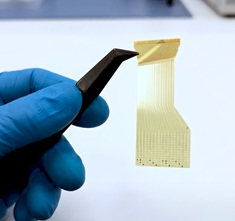
Inbrain Neuroelectronics today announced the successful completion and results of MINIGRAPH, a European Innovation Council (EIC)-funded project evaluating a minimally invasive neuromodulation implant and implantation procedure based on “groundbreaking” graphene technology for treating brain disorders.
The MINIGRAPH consortium has developed ultra-thin graphene neural interfaces, implantable electronics and autonomous software, together with a minimally invasive robotic implantation procedure designed to enable more precise and potentially more scalable deployment of next-generation brain-computer interfaces (BCIs). That is according to an Inbrain press release.
Using Parkinson’s disease (PD) as its initial application, MINIGRAPH took an integrated approach to developing autonomous therapeutics. Inbrain notes that deep brain stimulation (DBS) is already used to treat PD, but next-generation autonomous therapies will require new chronic, implantable, medical-grade systems capable of precisely recording neural activity, interpreting those signals and delivering targeted neuromodulation in response.
With Inbrain leading the clinical translation of the technology, the consortium—coordinated by the Catalan Institute of Nanoscience and Nanotechnology (ICN2)—also included Interuniversity Microelectronics Centre (IMEC), Nanoflex Robotics, Fraunhofer-Gesellschaft (Munich, Germany), Leiden University Medical Center (Leiden, Netherlands), ETH Zürich (Zürich, Switzerland), and Palacký University Olomouc (Olomouc, Czechia).
“As BCI technologies move toward patients, making them available to more people will depend not only on our ability to manufacture advanced devices, but also on developing precise and reproducible ways to implant them,” said Jose Garrido, co-founder and chief scientific officer of Inbrain. “MINIGRAPH brought together the neural interface, intelligent electronics, autonomous software and robotics as a single integrated system. This work helps build the foundation for autonomous neurotherapeutics that can decode neural activity and deliver precise neuromodulation that can be accessible to more patients at scale.”
A major focus of MINIGRAPH was the development and evaluation of graphene-based neural interfaces designed to address limitations with existing electrode materials.
At the core of the project was Inbrain’s proprietary graphene-based, thin-film neural electrode technology, which formed the foundation for both cortical and subcortical neural probes. The consortium generated data supporting more than 10 years of projected stability through accelerated ageing tests, alongside functional performance demonstrated in laboratory and preclinical studies. The project also involved extensive toxicity and biocompatibility studies at the cellular and molecular levels to support the safety evaluation of graphene-based neural technologies.
Nanoflex Robotics and ETH Zürich developed the robotic implantation system for the MINIGRAPH graphene neural electrodes based on remote magnetic navigation, contributing the electromagnetic robotic interventional system and leading development of the human-machine interface. MINIGRAPH also developed a new robotic surgical procedure for minimally invasive implantation of ultra-thin cortical and subcortical neural probes.
According to Inbrain, the consortium adapted a magnetic carrier to deploy the ultra-thin probes, and a robotic system designed to precisely guide cortical and subcortical implants along both straight and curved trajectories under X-ray imaging, giving surgeons “many more options and precision” during device implantation. The robotic implantation procedure developed by Nanoflex Robotics and ETH Zürich was validated both in vitro and in vivo within a large animal model.
By combining magnetic navigation with ultra-thin neural probes, the project established a potential pathway towards faster, more reproducible implantation while preserving electrode functionality. This technology could help transform neural implantation from a highly specialised surgical procedure into a more widely accessible therapeutic approach, Inbrain claims in today’s release.
“The MINIGRAPH project demonstrated the feasibility and potential to use electromagnetic robotics to control the delivery of next-generation BCI not only though straight but also curved trajectories deep into the brain with submillimetre accuracy. This will give surgeons in the future more options of how they can implant these groundbreaking devices,” commented Matt Curran, co-founder and chief executive officer (CEO) of Nanoflex Robotics.
MINIGRAPH brought together the individual technologies required for an autonomous neuroelectronic therapeutic system. Through the project, the consortium developed epicortical and subcortical graphene neural probes, advanced and validated implantable electronics designed to interface with the probes, integrated the probes and electronics into a functional prototype, developed the robotic implantation procedure, and advanced autonomous software for brain neuromodulation. The integrated implantable prototype was subsequently functionally validated in a translational model.
The consortium also advanced compact implantable electronics capable of decoding signals from hundreds of neural sites while enabling precision neuromodulation, together with dedicated software and signal-processing capabilities designed to support autonomous therapeutic operation. The project’s longer-term objective is to enable neuroelectronic systems that continuously record neural activity, interpret disease-relevant signals, and deliver precise, targeted neuromodulation in response, creating autonomous therapies personalised to each patient’s neural activity.
Separately from MINIGRAPH, Inbrain is collaborating with Robeauté to explore how microrobotic neurosurgical technologies could make neural implantation more precise, scalable and accessible, the company’s press release adds.