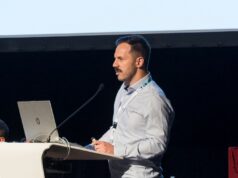
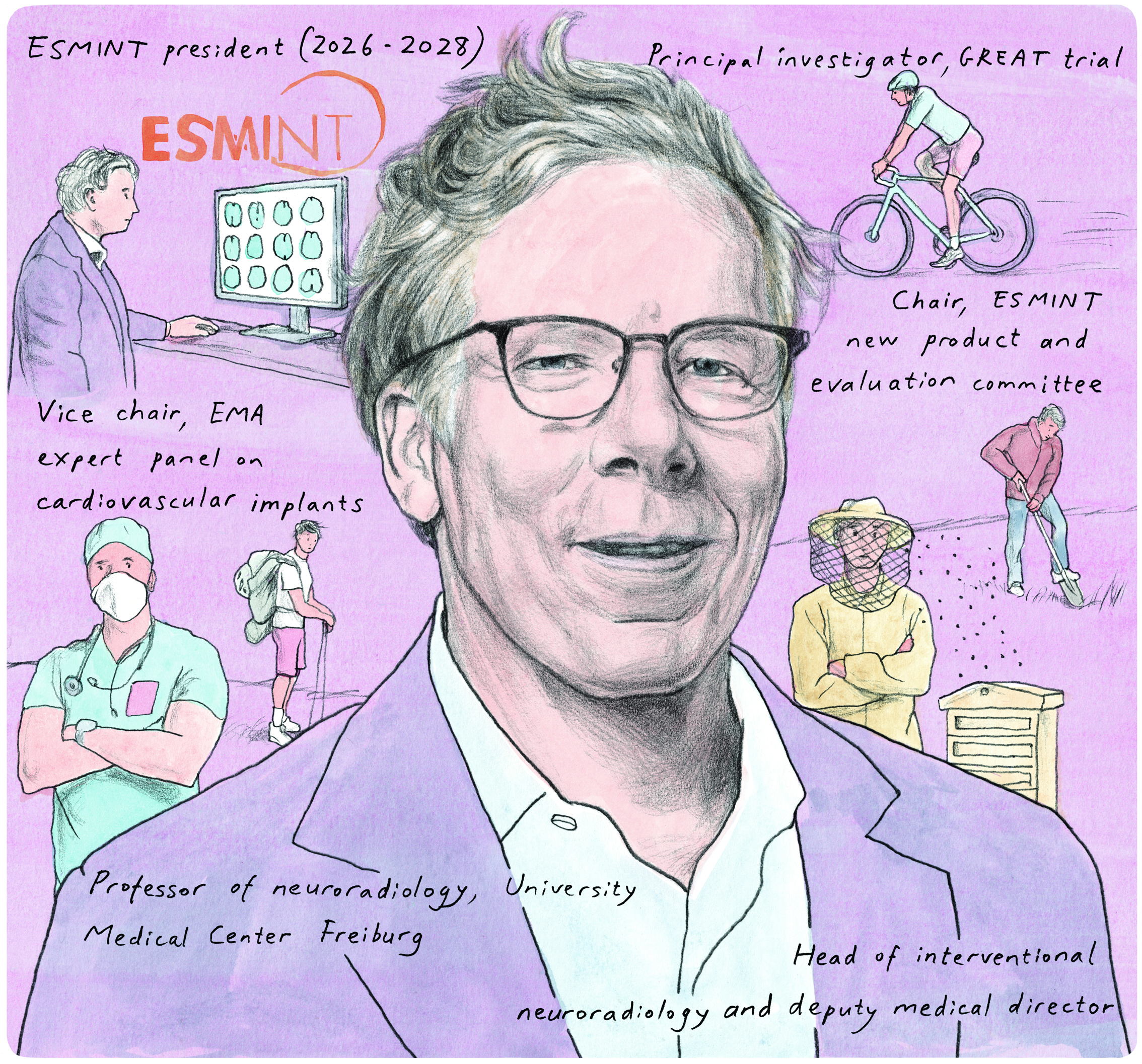
Having recently been confirmed as the new president of the European Society of Minimally Invasive Neurological Therapy (ESMINT) for 2026–2028, Christian Taschner’s (Freiburg, Germany) significant contributions to the interventional neuroradiology (INR) field—as a clinician, researcher, author and educator—look set to continue in earnest. Here, Taschner—deputy medical director and head of INR in the Department of Neuroradiology at University Medical Center Freiburg—discusses this field and his distinguished career to date with NeuroNews.
What initially drew you to medicine, and to the field of neuroradiology specifically?
I come from a family with a long tradition in law and religious scholarship, so choosing a career in medicine made me something of an outlier. My initial interest grew from a general fascination with the life sciences during my school years in Brussels, Belgium. The decisive personal influence, however, was a close family friend who worked in internal medicine in the Black Forest in Germany. The way he combined a deep seriousness of purpose with humour, genuine humanity and warmth left a profound and lasting impression on me. When I was 17 years old, I spent a month during the summer working as an observer in his department. By the end of that experience, I knew that medicine was what I wanted to do in life.
Neuroradiology came later. While working on my doctoral thesis at the Charité in Berlin, Germany—focusing on functional magnetic resonance imaging (MRI) and image-guided therapy—I became increasingly drawn to neuroimaging. During my training in diagnostic neuroradiology in Switzerland, however, I realised that diagnosis alone was not enough for me. I wanted more contact with patients and the opportunity to contribute directly to their treatment. This ultimately led me to a fellowship in INR in France, and into a field that brings together imaging, technology, clinical decision-making and hands-on therapy in a uniquely fascinating field.
Who have your mentors been, and how have they impacted your career?
In German academic medicine, mentorship has traditionally been less formalised than in some other academic cultures. In Switzerland, Daniel Rüfenacht gave me important support and opened the door to the University Hospital in Lille, France—and, with it, the fascinating world of neurointerventions. In Lille, Jean-Pierre Pruvo and Xavier Leclerc welcomed me with remarkable generosity and warmth. In fact, not only the department in Lille but the French neurointerventional community as a whole proved exceptionally open and supportive—even to a Belgian-German-Swiss physician with a rather creative command of their beautiful language at the time.
Martin Schumacher subsequently gave me the opportunity to return to Germany, where I have worked ever since. During this period, I also learned a great deal from Ajay Wakhloo, who helped me deepen and sharpen my scientific thinking. His support gave me a much better understanding of the technological foundations of our specialty. The longer I reflect on this question, the clearer it becomes that many other individuals have had a lasting impact on my career—far too many to name here. Much of this influence arose through the professional platforms that are so important in our small and highly specialised field. Meetings like the ESMINT congress, ABC WIN seminar, LINNC course, SNIS annual meeting and WFITN congress are places where ideas are exchanged, challenged, and debated—and ultimately developed into new projects and collaborations.
What are your main goals during your tenure as ESMINT president?
Many excellent initiatives are already well established within ESMINT and have been developed to a very high standard. I therefore see my role less as someone who needs to reinvent the society and more as someone entrusted with carrying the flame for the next two years—an honour and a privilege. A central theme of my tenure will be evidence. Through my work in device evaluation within ESMINT and as vice-chair of a European Medicines Agency (EMA) expert panel on cardiovascular implants, I have become increasingly engaged with the question of how we evaluate techniques, procedures and devices in medicine. INR is an innovative specialty, and innovation is one of its defining strengths, but innovation must be accompanied by robust data, transparent evaluation and a willingness to subject our own procedures to the same critical scrutiny that we expect from others. My goal is therefore to place evidence for INR techniques, procedures and devices at the centre of the agenda, while continuing to support education, training, collaboration with neighbouring disciplines, and opportunities for the next generation of neurointerventionists.
How do you feel ESMINT has changed in the years since you first joined?
I have been an ESMINT member since 2010 and a member of the executive committee since 2014. When I first became involved, ESMINT was a highly motivated community centred largely around its annual congress in Nice, France. Since then, it has evolved into a much broader, more structured and more influential professional society. The congress remains our flagship event but, today, ESMINT offers a comprehensive educational pathway—from ECMINT and EXMINT to hands-on skills training, online learning, fellowships, exchange programmes, and European diplomas. At the same time, the society has developed a much stronger research culture, supporting clinical studies, grants, guidelines, regulatory initiatives and international scientific collaboration. ESMINT has also become more inclusive and outward-looking. It provides dedicated platforms for early-career colleagues, women in neurointervention, nurses, technicians and radiographers, while strengthening cooperation with other medical societies, regulators, industry partners, and colleagues in regions where neurointervention is still developing.
In short, ESMINT has become much more than an annual congress. It has become a professional home for education, research, standards, collaboration, and a shared European identity in neurointervention. I hope younger colleagues will explore what the society can offer—and, just as importantly, help shape what it will become.
What are the three most impactful studies you have been involved with throughout your career?
Among the projects in which I have personally been involved, three stand out because, together, they trace the evolution of my own approach to evidence generation. The first is GREAT, an investigator-led, German-French randomised trial comparing second-generation hydrogel coils with bare platinum coils in the treatment of intracranial aneurysms. It gave me first-hand insight into both the value and the practical challenges of randomised device trials. The second is the multicentre Derivo study of flow diversion for unruptured intracranial aneurysms, which helped me understand what well-designed, prospective, non-randomised studies can contribute—and where their methodological limitations lie.
The third is our recently published European multi-society consensus on clinical evidence standards for high-risk endovascular stroke devices under the EU Medical Device Regulation (MDR). This was not a conventional clinical trial, but an evidence-building project combining a systematic review with a clinician-led Delphi process. For me, it represents a further step: from conducting individual studies to helping define the standards by which future device trials should be designed and evaluated. And, in combination, these three projects mark a progression from testing a specific technology in a randomised trial, to evaluating new devices in prospective studies, to shaping the framework for evidence generation itself. Ultimately, the objective remains the same: to support meaningful innovation while ensuring that it rests on evidence that is both clinically relevant and methodologically robust, for the benefit of our patients.
What is your perspective on the recently presented results of the CREST-2 trial?
When I started in neurointerventions, EVA-3S and SPACE had just been published, followed shortly afterwards by ICSS. In patients with symptomatic carotid stenosis, these trials suggested a periprocedural advantage of carotid endarterectomy (CEA) over carotid artery stenting (CAS), and the impact on our daily practice was immediate; carotid stenting numbers fell dramatically. CREST-2 now moves the pendulum back. For me, its key message is that selected patients with high-grade asymptomatic internal carotid artery (ICA) stenosis can benefit from revascularisation, and that carotid stenting—and therefore neurointervention—has a legitimate role. The way forward should be careful patient selection and a balanced interdisciplinary approach, together with our vascular surgery colleagues.
What is the most pressing unmet need in the INR space right now?
The most pressing unmet need is not another device, but a more reliable basis for deciding whom to treat, how, and when. Our technical capabilities have advanced faster than our ability to distinguish patients who are likely to benefit from those in whom intervention may add little—or expose them to unnecessary risk. In many areas, we know what can be done, but not yet clearly enough what should be done. Addressing this will require better disease characterisation, validated prediction tools, comparative clinical data and follow-up centred on outcomes that matter to patients. The goal should be a more precise and individualised form of neurointervention, in which treatment decisions are driven by expected clinical benefit rather than technical feasibility alone.
Which research areas or innovations are likely to have the greatest impact on neurointerventional care over the next 10 years?
I expect the greatest impact to come not from a single disruptive technology, but from the convergence of advanced imaging, artificial intelligence (AI), and device engineering. Imaging and AI will increasingly support triage, risk stratification, procedural planning and real-time decision-making. At the same time, smaller, more navigable and less thrombogenic devices—including next-generation thrombectomy systems, surface-modified flow diverters, and improved intrasaccular implants—should make treatment safer and reduce the need for prolonged antiplatelet therapy. Simulation and competency-based training will help shorten learning curves, while robotic or remote assistance may eventually improve consistency and broaden access to specialist care. The innovations that matter most will be those that make neurointervention more personalised, less invasive, and more reproducible—not simply more technically sophisticated.
What are your interests outside of medicine?
Above all, I value spending time with my family. We enjoy being in the mountains—hiking in summer and cross-country skiing or ski touring in winter. I am also a keen cyclist and particularly enjoy longer cycling tours. Music plays an important role in my life, and I sing in a vocal ensemble. At home, I like working with my hands, especially in the garden and with my bees. Together, these activities provide a welcome balance to my clinical and academic responsibilities.
If you had not chosen a career in medicine, what do you think you would be doing for a living today?
There is an old saying that, if you want to be happy for a lifetime, you should plant a garden. Had I not been fortunate enough to help cultivate the field of neurointerventions, I am sure I would have found another garden in which to live and grow. The great AI oracle has just delivered its verdict: apparently, I would have become a lawyer, a diplomat, or an engineer. A respectable selection, certainly, but I had hoped for something a little more out of the box.
FACT FILE
Current roles:
- 2026–2028: President, ESMINT
- 2020–present: Vice chair, European Medicines Agency Expert Panel on Cardiovascular Implants
- 2013–present: Deputy medical director, Department of Neuroradiology, University Medical Center Freiburg
- 2008–present: Head of INR, University Medical Center Freiburg
Education and training:
- 2004–2007: Fellowship in INR (Lille, France)
- 2002–2004: Fellowship in diagnostic neuroradiology fellowship (Basel, Switzerland)
- 2001–2002: Residency in neurosurgery (Zürich, Switzerland)
- 2001: MD (Berlin, Germany)
- 1997–2001: Residency in radiology (Berlin, Germany)
- 1990–1997: Medical studies (Berlin, Germany; London, UK)
Research interests:
- Clinical and preclinical evaluation of medical devices for INR
- Health services research in patients with neurovascular diseases
- Development and evaluation of non-invasive neurovascular imaging techniques