
Tenecteplase appears to be a safe and effective alternative to alteplase in the treatment of acute ischaemic stroke within 4.5 hours of symptom onset, as per the findings of an unadjusted interim analysis of individual patient data from numerous clinical trials comparing the two drugs over the past 15 years.
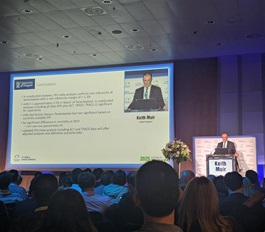
Presenting these new CATALYST-TNK data at the 2025 World Stroke Congress (WSC; 22–24 October, Barcelona, Spain), Keith Muir (University of Glasgow, Glasgow, UK) relayed that—based on the analysis’ primary endpoint of modified Rankin scale (mRS) scores of 0–1 at 90 days—tenecteplase reached prespecified non-inferiority margins at thresholds of both -3% and -1.3% (p<0.001) compared to alteplase.
The rates of mRS 0–1 were 56% across 2,177 patients treated with tenecteplase versus 53.7% across 2,186 patients treated with alteplase—an absolute difference of 2.3% that did not translate into statistically significant superiority with tenecteplase. Muir noted in his presentation that mRS distribution and rates of mRS 0–2 also showed a trend that favoured tenecteplase versus alteplase without reaching statistical significance.
The CATALYST-TNK meta-analysis included several randomised trials that have sought to evaluate tenecteplase given <4.5 hours from symptom onset in ischaemic stroke since 2010, including but not limited to the ATTEST, NOR-TEST, EXTEND-IA TNK, TRACE, ACT, TASTE and ORIGINAL studies.
“We have a significant number of different trials and, hitherto, we’ve had study-level meta-analyses that have suggested a trend towards improved mRS 0–1 outcomes when aggregating all of the data. In addition, safety data indicate non-significant differences in symptomatic intracranial haemorrhage [sICH] and mortality rates,” Muir said. “The motivation for an individual patient data meta-analysis was to see if we could harmonise these disparate clinical datasets, and conduct a series of analyses to more definitively establish the non-inferiority margin [with tenecteplase] and test for superiority.”
Despite a small number of “gaps” in the currently available datasets—primarily due to the CATALYST-TNK researchers having been unable, as yet, to obtain individual patient data from the ACT, TRACE and TRACE-2 trials—the analysis presented by Muir included close to 4,500 stroke patients randomised to receive either tenecteplase or alteplase across Australia, Canada, China, New Zealand, Norway and the UK.
In addition to the “highly significant” confirmation of tenecteplase’s non-inferiority to alteplase based on respective rates of mRS 0–1, Muir reported that incorporating the already-published data from ACT, TRACE and TRACE-2 into CATALYST-TNK’s current, interim analyses ultimately saw tenecteplase achieve statistical superiority over alteplase. Here, mRS 0–1 rates were 53.2% in 3,741 tenecteplase patients versus 50.7% in 3,706 alteplase patients.
Moving on to discuss the safety endpoints analysed, Muir stated that the presently available data from CATALYST-TNK “confirm” that there are no significant differences between tenecteplase and alteplase, with rates of mortality, sICH and fatal ICH within seven days all proving to be statistically similar between the two drugs. He also highlighted the “rather low” sICH prevalence of roughly 2% associated with tenecteplase in the analysis.
“In due course, we will [incorporate] the individual patient data from these additional trials, and we hope this will offer even more definitive outcomes,” Muir concluded.