
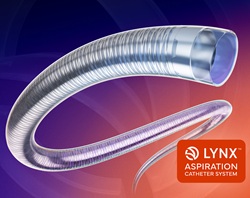
Q’Apel Medical has announced the US launch of the Lynx aspiration catheter system, an advanced family of catheters that supports physicians performing mechanical thrombectomy in the treatment of patients with acute ischaemic stroke due to vessel occlusion.
Following its US Food and Drug Administration (FDA) clearance, the Lynx system is now commercially available across the USA.
Q’Apel notes in a recent press release that, as procedural techniques evolve, physicians need technologies that enable efficient access and clot retrieval while navigating increasingly complex anatomy.
The company also states that, having been designed specifically for the demands of stroke intervention, the Lynx aspiration catheter system delivers responsive performance with seamless tracking, optimised versatility, and the navigability and support physicians require to access complex cerebrovascular anatomy. Together, these design characteristics provide the flexibility and control needed to efficiently adapt to changing flow dynamics during time-sensitive thrombectomy procedures, according to Q’Apel.
“While every stroke case presents unique anatomical challenges, my goal remains to perform the fastest and safest thrombectomy for every patient,” commented Kaustubh Limaye (Indiana University School of Medicine, Indianapolis, USA). “The Lynx aspiration catheter system offers three highly trackable catheters, each sized to track through the next, that work seamlessly together. This innovation sets Lynx apart, giving me the flexibility to select the right catheter for the vessel. In stroke, where every minute matters, this can be the difference between a timely save and procedural delays.”
Lynx is the second product built on the proprietary Q’Apel Laser Cut Tube (QLCT) technology, extending the company’s differentiated engineering platform into the aspiration category. Its bimetal shaft design balances proximal support with distal flexibility, and—as claimed by Q’Apel—the unique, open-spaced nitinol structure delivers excellent kink resistance and structural resilience, which are key to maintaining lumen patency, preserving deliverability, and transmitting force effectively. The unified Lynx platform includes three inner diameter (ID) sizes—0.044-inch, 0.058-inch and 0.072-inch—for optimal vessel-to-catheter ratios and coaxial compatibility across all sizes.
“Lynx marks an important step forward for Q’Apel, extending our proprietary QLCT technology into aspiration, and bringing its precision and engineering advantages to the complex, time-sensitive demands of stroke thrombectomy,” stated Jeff Krolik, chief technology officer at Q’Apel. “With a versatile family of aspiration catheters designed to perform across a wide range of anatomies and procedural needs, Lynx demonstrates how QLCT translates engineering innovation into meaningful procedural performance. More broadly, Lynx reflects Q’Apel’s continued evolution toward a broader neurovascular portfolio focused on solving real-world procedural challenges with differentiated technology that exceeds expectations.”