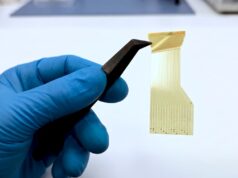
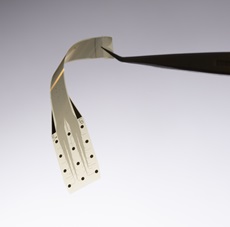
Inbrain Neuroelectronics has announced completion of patient recruitment in a first-in-human study evaluating its graphene-based brain-computer interface (BCI) technology. A total of 10 patients were recruited into the first-in-human study, and eight patients were treated surgically, with no perioperative device failure observed during use. Complete datasets were obtained from eight patients, as relayed via an Inbrain press release.
The study—sponsored by the University of Manchester and conducted with Northern Care Alliance National Health Service (NHS) Foundation Trust (both Manchester, UK)—evaluated Inbrain’s graphene-based cortical interface during neurosurgical procedures for brain tumour resection. The primary objective was to assess safety, with secondary objectives focused on signal quality, stability, stimulation capability, and suitability for intraoperative use with standard surgical tooling and recording equipment.
The study demonstrated a favourable perioperative safety profile with no device-related adverse events observed in all eight patients treated up to surgical discharge. The primary endpoint of the study includes a postoperative safety monitoring period of 90 days, which incorporates imaging.
In the study, Inbrain’s graphene electrodes were used alongside standard-of-care monitoring systems during tumour resection procedures. In select cases involving awake surgery, patients performed functional tasks, such as object naming, enabling researchers to evaluate the system’s performance to decode speech representation in the brain in high resolution.
“The completion of patient enrolment in this first-in-human study marks an important step for Inbrain and the field of neurotechnology,” commented Carolina Aguilar, chief executive officer (CEO) and co-founder at Inbrain. “Graphene has the potential to fundamentally change how we interface with the brain, enabling higher resolution of neural function-specific biomarkers, [and] safer and more intelligent BCI systems. We look forward to announcing the full results this year as we advance towards commercialisation.”
“The ability to detect high-frequency neural activity with micrometre-scale precision and also modulate it provides a fundamentally new level of insight into brain-tumour interactions, and functional brain decoding and mapping,” said David Coope (Manchester Centre for Clinical Neurosciences, Manchester, UK). “This level of resolution has the potential to significantly improve surgical precision and open new avenues for treating neurological disorders.”
“This study demonstrates that graphene can safely interface with the human brain, and capture neural signals with exceptional fidelity and resolution to enable precise decoding of brain and speech-related patterns metals can barely see,” added Inbrain co-founder Kostas Kostarelos. “It marks a pivotal step towards translating a new enabling technology using neural signals into meaningful clinical applications and real-world patient benefit.”