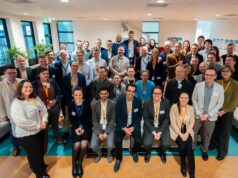
A team at the Technical University of Munich (TUM) University Hospital in Munich, Germany has implanted a brain-computer interface (BCI) in a patient paralysed from the neck down, marking the first procedure of this kind to be performed in Europe.
The TUM team hopes to enable Michael Mehringer, the 25-year-old man who received this BCI device, to control his smartphone and a robotic arm using only his thoughts—and they believe the implant in question will enable research that could one day help restore independence and improve quality of life for patients. The researchers are now seeking additional participants in this study.
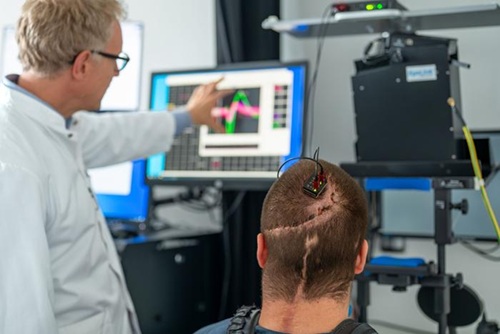
After extensive preparation and planning, the neurosurgery team at TUM University Hospital implanted a custom-made BCI during a surgery that lasted more than five hours. The device’s 256 microelectrodes are able to capture signals from the part of the brain that plans and executes complex grasping movements, according to the researchers.
“The greatest challenge was to implant the electrodes with absolute precision,” explained Bernhard Meyer (TUM University Hospital, Munich, Germany). “That’s the only way to obtain accurate recordings and measure brain signals reliably.”
“With this procedure, a BCI was implanted for the first time in Europe in a patient with quadriplegia,” added Simon Jacob (TUM University Hospital, Munich, Germany). “We are proud to be the first academic institution in Europe to have implanted two such devices.”
In 2022, the TUM team implanted another BCI device in a stroke patient with a language disorder, which made it possible to map language processing in the healthy right hemisphere of her brain.
With the surgery complete, the research phase of the team’s work is now underway. Mehringer and the researchers meet in the lab twice each week. A computer is connected to his implant via a port, and the system extracts neuronal activity from the transmitted signals. These data are then used to train artificial intelligence (AI) algorithms to associate specific patterns of brain activity with the movements Mehringer intends to make.
The next step is to use the decoded brain signal to control a mouse click or a cursor on a screen. And the hope is that, following this, Mehringer will learn to control a robotic arm for grasping objects.
“Rather than expecting humans to conform to and learn how to operate robotic systems, the focus is on designing systems that recognise human intent,” said Melissa Zavaglia (Munich Institute of Robotics and Machine Intelligence [MIRMI], Munich, Germany).
After a couple of weeks of training, the team has achieved its first breakthrough: as Mehringer attempts to follow a cursor moving across a monitor, the researchers can tell from his brain signals where he is intending to move.
In developing new solutions for people with severe physical disabilities, the Munich-based research team says it sees itself in direct competition with institutions in the USA. According to Jacob, in the USA, there has been major investment in BCI research over the past 20 years.
“Our goal is to close the gap between Europe and the USA by taking on projects that aren’t possible anywhere else,” he noted. “That requires bringing together all the key disciplines in one place: medicine, neuroscience—including AI—and engineering. Worldwide, very few universities combine these three disciplines as effectively as the Technical University of Munich.”
The researchers are hoping to achieve further major breakthroughs in the coming years, and they are currently seeking young adults from the Munich area with high-level spinal cord injuries—for example, those caused by diving or traffic accidents—to join this study.
“We’re looking for people with a pioneering spirit and a positive outlook on life,” Jacob stated. “However, it’s important for participants to understand that this is research, not treatment. The outcome of research is not as predictable as, for example, taking a painkiller that has been refined and tested for decades.”