 Medtronic announced this week that its Onyx liquid embolic system is now indicated for embolisation of the middle meningeal artery (MMA)—as a surgical adjunct—to treat patients with symptomatic subacute or chronic subdural haematoma (SDH) in the USA.
This makes the Onyx 18 and 34 systems the first products to gain an indication for adjunctive MMA embolisation in non-acute SDH patients, meaning they can be used ‘on-label’ in such cases.
“This approval is clear evidence of a change in standard of care,” said Adam Arthur, chief medical officer at Medtronic, speaking to NeuroNews. “For the first time in the USA, we now have a rigorously studied, evidence-based therapy that, when added to surgery, reduces the risk of recurrence and reoperation. Many patients are older, more vulnerable individuals, and some of them suffer through a cycle of surgery, recovery, relapse and more surgery. This expanded approval of the Onyx liquid embolic system offers a safer, more durable solution that interrupts the underlying vascular process responsible for recurrence.”
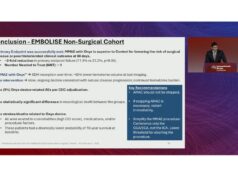
A key driver of this new indication was the Medtronic-sponsored, multicentre, prospective, randomised EMBOLISE trial comparing MMA embolisation using the Onyx liquid embolic system as an adjunct to surgery versus surgical management alone in the treatment of symptomatic subacute and chronic SDH.
Results from EMBOLISE were initially presented at last year’s International Stroke Conference (ISC; 7–9 February 2024, Phoenix, USA) and subsequently published in the New England Journal of Medicine in November 2024.
Within the study, the Onyx liquid embolic system demonstrated a decreased rate of recurrence and reoperation of roughly 63% when combined with surgery. In addition, there were no Onyx device-related adverse events up to 180 days, and no deaths attributed to the Onyx system or the MMA embolisation procedures in the trial.
Linnea Burman, president of Medtronic’s neurovascular business, told NeuroNews: “Data show Onyx delivers a threefold reduction in recurrence or reoperation compared with surgery alone. This new indication transforms MMA embolisation from a promising technique to a proven tool we can offer patients and clinicians to reduce recurrence, avoid repeat surgery, and improve long-term outcomes.”
Medtronic notes in a press release that, following this expansion, its dedicated principal investigators and research teams are continuing to analyse the data from EMBOLISE in order to provide additional insights and further advance chronic SDH treatment.