
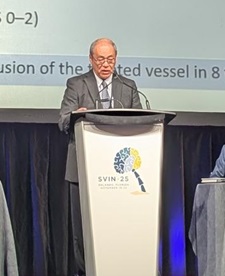
A novel stent designed specifically for the treatment of large vessel occlusion (LVO) ischaemic strokes caused by underlying intracranial atherosclerotic disease (ICAD) has demonstrated its safety and efficacy within a multicentre study in Japan.
Delivering these late-breaking data at the 2025 Society of Vascular and Interventional Neurology (SVIN) annual meeting (19–22 November, Orlando, USA), Nobuyuki Sakai (Kobe City Medical Center General Hospital, Kobe, Japan)—the study’s principal investigator—reported that the TG dilator (TG Medical) “consistently improved blood flow”, achieving an 86.7% rate of modified thrombolysis in cerebral infarction (mTICI) ≥2b revascularisation without causing any significant adverse events.
With the goal of building on positive findings from a first-in-human trial of the TG dilator—a new, self-expandable, dual-layer stent-angioplasty device—Sakai and his colleagues devised a pivotal study to further evaluate its performance in ICAD-related LVO strokes. In this prospective, multicentre, single-arm, open-label, non-randomised, investigator-initiated study, a total of 30 patients were enrolled across 10 Japanese stroke centres between July 2024 and April 2025.
The occluded target vessel in the majority of these patients was either the M1 (n=18) or M2 (n=6) segment of the middle cerebral artery (MCA). Prior to treatment with the TG dilator, four patients had received intravenous recombinant tissue plasminogen activator (rtPA) and 15 had undergone a mechanical thrombectomy procedure. Additionally, all 30 patients were prescribed a loading dose of aspirin with prasugrel.
Outlining the study’s results, Sakai stated that the TG dilator was successfully navigated to the target lesion in all cases, also relaying a median application time of 11.5 minutes. Immediately following the procedures, “significant” recanalisation (mTICI ≥2b) was observed in 26 out of 30 cases (86.7%), with rescue therapies—including additional stent angioplasties—only being required in three cases (10%). There was also one case in which the microcatheter could not be passed, Sakai added.
The study’s clinical outcomes revealed that, although reocclusion occurred in one patient (3.3%) and another experienced recurrent ischaemic stroke (3.3%) within 90 days, a modified Rankin scale (mRS) score of 0–2 was attained in 21 of 30 patients (66.7%) at the same timepoint. The investigators also detected no instances of intracranial haemorrhage (ICH), device failure, distal embolism, vasospasm, dissection or perforation requiring intervention.
Sakai concluded that, while the tools currently available for treating ICAD-related LVO strokes are off-label and “may not be scalable”, these data indicate that the TG dilator can be considered safe and effective for this indication—and the team behind it is now planning a widespread rollout of the device.