Following two years of research, the UK-based charity Hereditary Brain Aneurysm (HBA) Support has launched a new report revealing “significant gaps” in the screening and care that people with the familial disease receive, potentially putting patients at risk of “preventable tragedies”. The report also highlights an “urgent need for action” to ensure consistent, equitable care.
“Early detection and regular monitoring saves lives,” said ROAR study chief investigator Diederik Bulters (University Hospital Southampton, Southampton, UK). “This report shows why we need clear, personalised guidelines for patients at hereditary risk.”
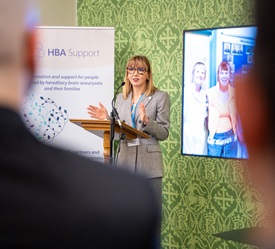
HBA Support’s report was launched via an event that took place at the UK Houses of Parliament in London on 10 February, and was sponsored by UK member of parliament (MP) Amanda Hack.
“Families with a history of aneurysms are being left to fight for screening that could save their lives,” said HBA Support founder and chair Rebecca Middleton, speaking at the report launch. “Patients who suffer ruptures are too often left to piece together their own rehabilitation journey after a subarachnoid haemorrhage [SAH]. Despite care for SAH patients featuring in three sets of NICE [National Institute for Health and Care Excellence] guidelines, they often have to piece together their own rehabilitation pathway. Our report shows a system full of gaps—and thousands of patients and families are paying the price.”
Andy Motch—who suffered a brain aneurysm rupture after being told he was not at risk despite his father dying from an aneurysmal brain bleed—also shared his story at the event, stating: “The NHS [National Health Service] saved my life, but the care system for patients like me is broken. I’m terrified of what happens next.”
The report shared by HBA Support indicates that Andy’s experience is shared by families across the UK, revealing widespread gaps in screening, inconsistent follow‑up care, and hundreds of preventable ruptures every year, according to the charity. HBA Support also notes in a press release that the majority of brain aneurysms can be successfully treated if identified prior to rupturing and, using hereditary history as guidance, patients can be screened and treated before haemorrhagic complications arise.
Speaking of the launch event in London, Middleton added: “This week, something powerful happened. More than 70 people—neurosurgeons, INR [interventional neuroradiology] specialists, neuro nurses, researchers, policymakers, genetic counsellors, patients and partners—came together with a shared purpose: to change the future for families affected by brain aneurysms. The conversations were honest, hopeful, and full of momentum. Our report landed with real impact, and the appetite for partnership was unmistakable. Many thanks to Amanda Hack MP and Medtronic for their support to make this happen. This is what hope in action looks like, and we’re only just getting started.”
HBA Support has shared several recommendations for change as the charity calls for action from UK government and NHS leaders, including but not limited to: national cascade screening guidelines and formal recognition of hereditary brain aneurysms as a genetic condition; better infrastructure in terms of data collection, general practitioner (GP) education, genetic counselling, and psychosocial support; and consistent rehabilitation for survivors, in line with stroke pathways.
Additionally, HBA Support has been involved in driving forward the ROAR study—a research programme that is investigating why some brain aneurysms rupture while others remain stable by analysing genetic, biological and clinical factors across thousands of patients. Its goal is to build the first robust, evidence‑based tools for predicting rupture risk in an effort to “transform” screening and treatment for families with hereditary aneurysms.
The charity has also written an open letter to Wes Streeting, the UK secretary of state for health and social care, asking the country’s health department to read the report and take urgent action.