
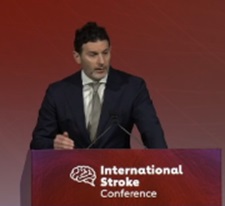
Middle meningeal artery embolisation (MMAe) has been shown to result in the twofold reduction of a study endpoint including poor clinical outcomes and need for open surgery, as compared to observation, in mildly symptomatic chronic subdural haematoma (cSDH) patients. Presenting these new data from the ‘EMBOLISE 2’ trial at the 2026 International Stroke Conference (ISC; 4–6 February, New Orleans, USA), Jared Knopman (Weill Cornell Medical College, New York, USA) also emphasised the importance of keeping MMAe procedures simple and adhering to optimised medical management in order to minimise stroke risks in this population.
EMBOLISE 2, for which Knopman is the co-principal investigator alongside Jason Davies (State University of New York, Buffalo, USA), represents the second half of the wider EMBOLISE randomised controlled trial—a prospective, multicentre study conducted across 60 US centres to evaluate MMAe in the treatment of cSDH.
Primary data from what is now being dubbed ‘EMBOLISE 1’ comparing MMAe plus surgical drainage to surgical drainage alone were presented two years ago at ISC 2024, and ultimately led to Onyx (Medtronic)—the liquid embolic agent used in the trial—gaining an updated US Food and Drug Administration (FDA) indication covering non-acute SDH.
Speaking at this year’s ISC, Knopman specified that EMBOLISE 2 sought to compare MMAe treatments to the more conservative approach of observation and, as such, enrolled a more mildly symptomatic cSDH population relative to its predecessor. This was reflected in EMBOLISE 2’s enrolment criteria, as only patients with haematomas that were ≤15ml in volume and had <5ml of midline shift were included, while those with more severe motor weakness were excluded. A total of 200 patients were randomised 1:1 to receive either upfront MMAe or observation only.
“EMBOLISE 2 represents the first and only trial to date that was specifically powered to study this more mildly symptomatic patient population,” Knopman commented.
Primary results
Relaying late-breaking data from EMBOLISE 2, the presenter said that the MMAe group in EMBOLISE 2 saw a twofold reduction in the rate of patients who experienced the trial’s primary endpoint—a composite of either need for surgical drainage, a poor clinical outcome, or clinical deterioration, at 90 days—as compared to the observation group (11.9% vs 23.2%, respectively). And, while the trial was not powered to draw conclusions based on the separate components of this endpoint, all three indicated a comparable or even greater reduction with MMAe versus observation when considered individually.
“It’s also impressive that, even in this more mildly symptomatic patient population, the number needed to treat here was only nine,” Knopman added. “This has vast implications for a disease state that affects an ever-growing number of our patients.”
Follow-up assessments of deterioration in neurologic function on the modified Rankin scale (mRS) revealed that MMAe failed to achieve non-inferiority compared to observation at 90 days, but did achieve non-inferiority at 180 days—an outcome that Knopman labelled “somewhat unsurprising”, as adverse events and complications are considered more likely to occur early on in the experimental arm of any trial comparing an interventional treatment to conservative management.
“What we did find surprising, however, was that the conservatively managed group did not have a benign course, and they paid the price further down the line for consistently having that haematoma burden,” he continued. “The takeaway here is that these patients are starting out with smaller haematomas and it may take longer for their symptoms to manifest—but, over time, they end up doing so.”
According to Knopman, this conclusion is bolstered by the fact that volumetric analyses performed at both 90 and 180 days revealed statistically significant reductions in haematoma size in the MMAe group compared to the observation group, with the average volume at 180 days being almost halved in MMAe versus observation patients (43.8ml vs 80ml, respectively).
Lessons learned
The presenter went on to detail that the EMBOLISE investigators were initially “concerned” to see a 5.9% rate of stroke in the MMAe arm, contrasting with 0% in the observation arm.
“None of these strokes in the treatment group were related to Onyx,” he relayed. “We did a deep-dive into what caused those strokes and we found that three of those six strokes occurred in patients who were previously on antiplatelet or anticoagulation medications, but those medications were [subsequently] withheld; two were due to catheterisation of the internal carotid artery, one which resulted in dissection and one that led to a shower of emboli; and one was due to underlying medical history in a patient with a very high CCI [Charlson comorbidity index] score.”
Knopman noted that further analyses revealed a greater stroke risk in patients with elevated CCI scores, describing this as an “immutable feature” within cSDH patient populations.
“However, the fact that five of these six strokes could’ve been mitigated against or prevented taught us a couple of things about the [MMAe] procedure,” he continued. “One is that antiplatelet and anticoagulation medications for secondary stroke prevention should not be stopped in this patient population—and, if stopping them is necessary, they should be restarted [as soon as possible].”
Expanding on this point, Knopman noted that he and his colleagues found “no evidence” in the current literature indicating that any benefits can be derived from halting these medications in non-surgically managed cSDH patients.
“I’m probably preaching to the choir at a conference like ISC in stressing the importance of secondary stroke prevention,” he added, “but I think the neurosurgical community—which is a little more reflexive in reversing these agents—can learn something from these findings.”
And, arriving at the second key lesson learned from EMBOLISE 2, Knopman commented that “the actual procedure should be kept simple”.
“You don’t want to perform potentially unnecessary catheterisations—for example, in the internal carotid artery, which doesn’t typically add to the optimisation or safety of the procedure,” he said, also suggesting that physicians may consider adopting a lower threshold for stopping the MMAe procedure in patients who have a more challenging aortic arch.
Rounding off the study’s safety endpoints, Knopman reported that the neurologic death rates between the two study groups were statistically comparable, with none of the four that occurred in the MMAe arm being attributed to Onyx or the patient’s haematoma directly. Additional analyses corroborated the notion that cSDH patients with higher CCI scores are more likely to experience negative clinical outcomes, with previously presented data from EMBOLISE 1 also supporting this.
Knopman concluded by highlighting the “very exciting” primary endpoint finding of EMBOLISE 2, but also reiterated the importance of optimising the MMAe procedure itself as well as ensuring that standardised medical management remains “top of mind”.
“By adhering to these key recommendations, we believe that we can mitigate the risk of diluting the robust clinical effects that embolisation has on primary-endpoint reduction and radiographic response—even in this mildly symptomatic patient population,” he added.