This advertorial is sponsored by Route 92 Medical.

Following the recent US Food and Drug Administration (FDA) clearance of the HiPoint Reperfusion System (Route 92 Medical) for aspiration-based mechanical thrombectomy—as well as the presentation of new clinical data affirming the system’s benefits in large vessel occlusion (LVO) stroke treatments—Ajit Puri (UMass Memorial Health, Worcester, USA) outlines his world-leading firsthand experience with the device, and discusses the “paradigm shift” set to be created by results from the SUMMIT MAX trial.
Having now used the 0.088-inch (088) HiPoint system for more than three years and in 150–200 cases, Puri describes it as “nothing short of phenomenal”.
“I used to be a belt-and-suspenders guy—balloon guide catheters, intermediate catheters, stent retrievers—but, given the simplicity of this procedure with the HiPoint Reperfusion System using the Monopoint Approach, it’s a one-and-done thing,” he comments. “In the last few years, I have almost completely transitioned to a super-large-bore platform for anything from carotid to MCA [middle cerebral artery] bifurcation. It has standardised a lot of our workflow.”
Here, Puri reiterates the applicability of Route 92’s system across a wide range of LVO locations, attributing this to its “softness” and agnosticism regarding catheter length.
“You don’t have to use different devices of different lengths to treat clots that are more distal versus more proximal—the HiPoint Reperfusion System provides uniform aspiration all the way from MCA bifurcations to carotid occlusions in the neck, and it has become my go-to device across those territories,” he continues.
A one-of-a-kind device
Outlining the characteristics of the HiPoint Reperfusion System that he most appreciates, Puri highlights the fact that it is a ‘catheter on a stick’, describing it as “the only 088 device” of its kind that has been cleared by the US FDA for per-se direct aspiration thrombectomy at the M1 segment of the MCA. He also draws attention to the benefits brought about Route 92’s ‘self-centring’ Tenzing catheter when it comes to navigating the 088 system through a patient’s neurovasculature.
“Our challenge used to be bringing these devices up to the MCA,” Puri explains. “This system has taken us from wondering if we will be able to achieve this, to almost complete predictability. We know the device will reach the MCA in a very high majority of cases, given there is very little ledge between the Tenzing catheter and the HiPoint super-bore catheter. It’s gone from ‘can we’ to ‘we can’.”
Puri cites experiences from the Super-large-bore ingestion of clot (SLIC) study, noting a 100% rate of success in navigating the HiPoint 88 Reperfusion System to the occlusion site across 33 consecutive LVO patients. The study—initially published online by Puri and colleagues in the Journal of NeuroInterventional Surgery in 2022—also found final modified thrombolysis in cerebral infarction (mTICI) 2b–3, 2c–3 and 3 rates of 100%, 94.1% and 73.5%, respectively, while first-pass revascularisation rates were 82% for mTICI 2b–3 and 70.5% for mTICI 2c–3. In addition, no postprocedural symptomatic intracranial haemorrhages (sICHs) were reported.
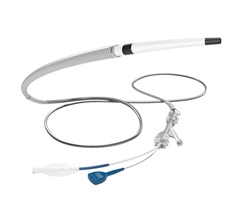
He likens the simplification of aspiration thrombectomy brought about by the HiPoint 88 Reperfusion System to the paradigm of carotid stenting—a “single operator-friendly” procedure whereby sufficient catheter length is not a major concern. Puri adds that it is “completely unique in our armamentarium”.
“Between the Base Camp guide catheter and the HiPoint catheter on a stick, you are agnostic to length, regardless of where the clot is,” he details. “When you insert the Tenzing into the HiPoint 88 super-bore catheter as a single assembly, it’s as seamless and as operator-friendly as it can get. And, when you’re doing a case in the middle of the night, you don’t need to be managing multiple flush lines and catheters—this system simplifies the procedure completely, while giving you the largest US FDA-cleared aspiration bore for LVOs to date.”
SUMMIT MAX data
Earlier this year, at the European Stroke Organisation Conference (ESOC; 21–23 May, Helsinki, Finland), results from the SUMMIT MAX randomised controlled trial (RCT) assessing the safety and efficacy of the HiPoint 88 Reperfusion System in comparison to the largest-bore conventional 0.074-inch aspiration catheter were presented for the first time.
SUMMIT MAX ultimately achieved its primary efficacy endpoint, with a significantly higher, superior revascularisation rate being achieved in the HiPoint arm versus the control arm across 166 analysed study participants, whereby usage of any adjunctive therapy (e.g. stent retriever) after use of the HiPoint Reperfusion System was considered a treatment failure. Route 92’s system was successfully delivered to the site of the stroke-causing occlusion in 89% of cases and no significant differences were observed between the two study groups regarding the primary safety endpoint of sICH occurrence.
Puri describes the SUMMIT MAX RCT—for which he was a co-national principal investigator alongside Thanh N Nguyen (Boston University School of Medicine, Boston, USA) and Guilherme Dabus (Baptist Health South Florida, Miami, USA)—as a “pivotal, science-moving paradigm shift” in interventional stroke care.
“This is the first RCT to date comparing the 088 system with another aspiration system—the largest aspiration system previously available in the USA,” he adds. “So, this actually moves the boundaries. It moves the goalposts in terms of how scientific evidence is going to be collected via RCTs for super-large-bore catheters in the future.”
Enrolling 250 patients in total across multiple sites, SUMMIT MAX saw “phenomenal success”, achieving rapid enrolment and subsequently meeting all of its primary efficacy and safety endpoints, Puri relays.
“Interestingly, the primary efficacy endpoint was kept to mTICI 2b–3 achieved using the study device only,” he goes on. “Any use of an ancillary device was considered a failure—so, the bar was set very high, but we reached it with flying colours. An mTICI 2b–3 revascularisation rate of almost 80% with the HiPoint Reperfusion System was attained, as opposed to just 51% in the control arm. That was a huge success in showing that it is highly deliverable and can achieve revascularisation outcomes that physicians are satisfied with.”
A further finding Puri highlights is the first-pass effect (FPE; mTICI 2c–3) of 47% observed across the trial’s entire HiPoint patient cohort—a figure that can be seen to justify the name of the device itself, standing as the highest FPE rate recorded in any stroke thrombectomy RCT to date, exceeding the likes of ASTER and PROST.
And, touching on the finding of comparable safety outcomes between SUMMIT MAX’s two study arms, Puri says: “As physicians who have been doing this for a long time, we are always asked if these 088 systems are safe in the MCA. Now, with multiple studies across different devices, we have seen that it is very safe to perform thrombectomies in the MCA using an 088 platform.”
Another detail Puri pulls from the SUMMIT MAX results is the even greater degree of success observed across the study’s three highest-enrolling sites, including a 96% rate of successfully accessing the MCA, a 68% rate of first-pass mTICI 2c–3 revascularisation, and adjunctive devices being required in just 4% of cases, all of which compare favourably to the average outcomes seen across the whole trial. Puri attributes these findings to the small learning curve associated with the 088 HiPoint Monopoint system.
“This tells us that, once physicians get used to the device, the outcomes are going to get even better in terms of navigability and revascularisation, as well as an incredible decrease in the need for ancillary devices,” he avers.
Puri concludes that, in his view, the SUMMIT MAX trial demonstrates Route 92’s commitment to furthering neurovascular care by collecting level one data and expanding the current indications for LVO strokes by “pushing boundaries—in a safe, ethical manner—all the way to the MCA”. He also notes that, with the HiPoint Reperfusion System, the company has added a “phenomenal tool” to the armamentarium of neurointerventionists, predicting that it will alter future stroke treatment paradigms.
See route92medical.com/safety-information for complete safety information.