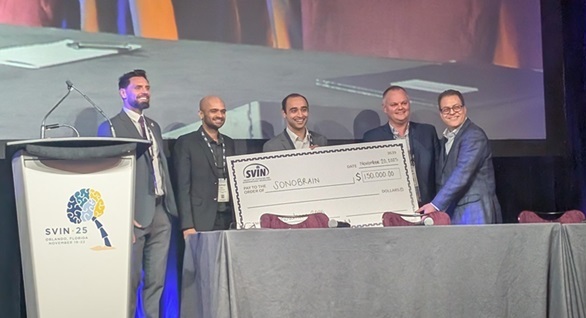
A novel solution intended to tackle one of the “biggest blind spots” in modern medicine—intracranial pressure (ICP) assessment—recently won the fourth annual SVINnovation competition, walking away from the 2025 Society of Vascular and Interventional Neurology (SVIN) annual meeting (19–22 November, Orlando, USA) with US$150,000 in prize money.
Following a pitch by Amol Mehta (Icahn School of Medicine at Mount Sinai, New York, USA), a panel of industry leaders selected Sonobrain Diagnostics’ fully automated, portable, head-mounted device designed to measure optic nerve sheath diameter (ONSD) as the standout innovation ahead of three other technologies showcased by fledgling companies during the session.
“I want you to imagine managing hypertension without a blood pressure cuff, or fever without a thermometer, or heart attacks without EKGs [electrocardiograms]; all these things sound absurd—because they are absurd,” Mehta said, discussing the context surrounding Sonobrain’s technology. “But, in essence, this is how we manage ICP today. It’s one of modern medicine’s biggest blind spots.”
According to Mehta, the use of ultrasound to examine the back of the eye and measure the diameter of the optic nerve sheath has demonstrated “good sensitivity and specificity” for qualitatively assessing ICP. However, while the requisite technology exists and “the science is solid”, scalability remains a major barrier, and the need for certain workflows, settings and expertise means ONSD evaluations are limited to large hospitals with specialised staff. Sonobrain’s automated solution is said to obviate this need for skilled operators who are not available at every centre.
“Simply place the device on the head and, within seconds, you get high-quality images, and an automated analysis of whether ICP is high or low,” Mehta described, also noting that this approach has the potential to remove operator variability and standardise ICP assessments.
The presenter went on to state that Sonobrain’s preliminary data show “excellent alignment” between automated and manual measurements, and the company is also currently engaging in strategic partnerships to develop robust datasets required to power its artificial intelligence (AI) models. Mehta highlighted critical care, military and defence, and sports medicine, among the many settings within which this technology could drive more cost-effective and reliable ICP evaluations. The fully external, non-invasive nature of the device will also foster a “low regulatory burden” and rapid path to commercialisation, Mehta added.
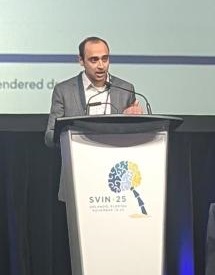
“The vital signs that we take for granted now were all, at some point, a manual measurement,” he concluded. “But, automation made them universal—and ICP is next. We already know how to safely estimate it; the barriers have been complexity, variability and workflows, and that’s what we’re trying to solve at Sonobrain. By automating ONSDs, we’re turning ICP into the next vital sign that’s measurable by anybody, anywhere.”
These arguments ultimately won over the SVINnovation expert panel. On behalf of his co-adjudicators—Vastrax chief executive officer (CEO) Ryan Bouchard, American Heart Association (AHA) chief science officer for brain health and stroke Mitchell Elkind, and Gravity Medical Technology co-founder and chief technology officer Shashvat Desai—Von Vascular CEO Manning Hanser described Sonobrain as a “very promising” company that is looking to solve a “massive need” in the neurovascular space.
Mehta and the Sonobrain team were subsequently awarded US$150,000 in cash, complimentary services and mentorship from industry experts—and will also be featured in the Stroke: Vascular and Interventional Neurology journal and on the SVIN website.
“This award from SVINnovation provides extremely valuable momentum for Sonobrain at an important point in our growth,” Mehta told NeuroNews. “We plan to use the prize to advance our device development, and support the technical and clinical activities that will guide our next phase. We are very thankful for this opportunity and thrilled to have received the award.”
Innovation across the board
While delivering the SVINnovation panel’s decision, Hanser was quick to note that the other three contestants showcased “amazing” solutions too, making it “very tough” to select a winner.
The first pitch during the session saw Astria Biosciences chief operating officer Aditya Mittal (University of Utah, Salt Lake City, USA) share his company’s cerebral aneurysm test (CAT) 7 solution, which has been designed to make the screening of ‘watchful waiting’ patients more simple, accurate and cost effective by assessing aneurysm rupture risks via a biomarker-based blood test. The test has already produced positive findings when evaluated in preclinical animal models and human samples, Mittal relayed.
Next up came Wesley Jones—CEO and co-founder of Vonova—outlining the potential held by the Cerebro Clear access device, a system intended to circumvent the need for open surgery in the drainage of chronic subdural haematomas (cSDHs). Jones argued that the transvascular evacuation enabled by this technology could lead to improved neurological outcomes and shorter hospital stays, also highlighting cortical neuromodulation and brain-computer interface (BCI) implantation as potential future indications.
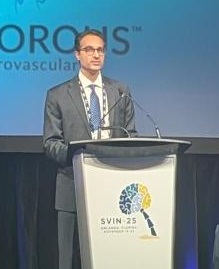
The session’s remaining presentation saw QAS.AI chief financial officer Vincent Tutino (University at Buffalo, Buffalo, USA) deliver a pitch laying out his company’s efforts to develop an intraoperative software solution that can provide real-time 3D visualisation of blood flow within the angio suite. According to Tutino, QAS.AI’s first indication of choice will be outcome prediction during brain aneurysm treatments, with automated modified thrombolysis in cerebral infarction (mTICI) scoring in ischaemic stroke representing a potential target further down the line.
“SVINnovation began three years ago and the level of competition has grown exponentially,” said Sunil Sheth (University of Texas Health [UTHealth], Houston, USA)—who moderated the 2025 SVINnovation session—speaking to NeuroNews. “This year, we had the greatest number of submissions from more inventors, disease spaces, backgrounds and countries than ever before. The talent and quality of the pitches we had to select from was substantially higher than before. We’re excited to see how rapidly this forum has grown in size of award, and sophistication, and hope to see it become the premier neurovascular venue in the coming years.”
Familiar faces
The 2025 SVIN annual meeting also saw last year’s SVINnovation winner—Matt Findlay (University of Utah, Salt Lake City, USA) of Soundpass—take to the podium to update attendees on how his company has utilised the US$100,000 prize it was awarded in 2024.
Findlay highlighted the conduction of eight cadaver trials, design of animal model studies, iteration of key device prototypes, ongoing breakthrough designation through the US Food and Drug Administration (FDA), and progress towards intellectual property (IP) across international markets, as the most notable areas within which the SVINnovation money has aided Soundpass’ efforts over the past 12 months.
As the company looks to further the development of its novel catheter for cerebrospinal fluid (CSF) drainage, its upcoming goals include a 510(k) regulatory submission to the US FDA as well as the appointment of a new CEO and more full-time employees. Findlay also noted that Soundpass is hoping to launch its technology commercially within the next 12–18 months.
Additionally, during the following day’s late-breaking trials session, Magnendo founder and CEO Yoonho Kim—who was named the inaugural SVINnovation winner back in 2022—presented new data on his company’s robotic guidewire featuring a magnetically deflectable tip. The goal of this novel solution is to “eliminate the experience gap” and enable more consistent, operator-independent guidewire navigation.
With qualitative assessments having already indicated that the device can reduce the likelihood of “undesirable behaviours” during a procedure and minimise variability between less versus more experienced operators, Kim reported that more recent preclinical quantitative evaluations have produced “very consistent” findings too—including Magnendo’s guidewire being associated with a significantly lower travel distance and remaining closer to the centre of the vessel as compared to conventional systems. These capabilities could lead to improved safety and efficiency during neurovascular procedures, Kim stated.