At this year’s Society of Vascular and Interventional Neurology (SVIN) annual meeting (19–22 November, Orlando, USA), Endovascular Horizons received the Best Abstract Award for its work in pioneering a transvascular neurosurgical approach to the treatment of subdural haematomas (SDHs).
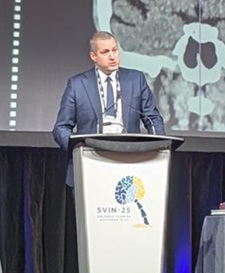
The latest data from the company’s first-in-human EMBODRAIN study evaluating this novel, fully endovascular procedure were presented by neurosurgeon and Endovascular Horizons founder Luis Savastano (University of California San Francisco [UCSF], San Francisco, USA) during a late-breaking trials session at SVIN 2025.
“Beyond SDH, this technology adds to the foundation for transvascular neurosurgery—a new paradigm that utilises endovascular access to treat traditionally non-vascular intracranial pathologies,” said Savastano, speaking to NeuroNews after receiving the award. “Its potential to transform intracranial therapeutics, improve access and reduce treatment morbidity is significant, and warrants further clinical investigation.”
Endovascular Horizons claims that, via its ‘Embodrain’ procedure, it is pioneering a “new generation” of transcatheter neurosurgical technologies—minimally invasive systems that “extend the reach” of endovascular medicine into conditions that have traditionally only been treatable with open surgery. In this new field, the company has elected to focus initially on treating non-acute SDHs, which are one of the most common neurosurgical conditions, and continue to grow in prevalence due to ageing populations and widespread use of anticoagulants.
The recently introduced Embodrain procedure integrates middle meningeal artery embolisation (MMAe) and catheter-based, endovascular subdural evacuation through the same arterial access, obviating the need for a craniotomy. A proprietary system of devices facilitates controlled perforation of the arterial wall and dura, enabling catheter navigation into the subdural space for drainage.
To evaluate this approach further, EMBODRAIN—a prospective, single-arm, first-in-human study—was conducted at Clinica La Sagrada Familia in Buenos Aires, Argentina, enrolling 16 consecutive patients with symptomatic, non-acute SDH, two of whom were ultimately excluded due to anatomical restrictions precluding embolisation. All procedures in the study were performed using a dedicated endovascular system designed for MMAe followed by transarterial perforation and subdural drainage, with technical success being defined as: successful embolisation; safe access to the subdural space; effective haematoma drainage; and vessel closure without adverse events. Clinical success was defined as SDH resolution without the need for surgical conversion. Patients were followed clinically and radiographically for six months.
As per new results presented at SVIN 2025, all 14 treated patients (mean age, 73.6 years; 80% male) underwent successful MMAe and transvascular subdural drainage without intraoperative complications or need for surgical backup. SDH volume was reduced by an average of more than 65%, and midline shift improved from 9.7±3.8mm to 4.2±2.1mm. Functional status also improved rapidly, with modified Rankin scale (mRS) scores decreasing from a mean of 2.7 to 1.3, and Markwalder grading scale scores decreasing from 1.9 to 0.7 within 72 hours. Furthermore, there were no haemorrhagic complications, neurologic deteriorations, or radiographic reaccumulations, and none of the enrolled patients required intensive care unit (ICU) admission or anticoagulation reversal.
Under the leadership of principal investigator Pedro Lylyk (Equipo de Neurocirugía Endovascular y Radiología Intervencionista [ENERI], Buenos Aires, Argentina), the EMBODRAIN researchers therefore conclude that this first-in-human experience establishes the safety, technical feasibility and early clinical effectiveness of fully endovascular treatment in non-acute SDH—adding that the approach provides a “streamlined, minimally invasive solution” that integrates embolisation and haematoma evacuation into a single transvascular session.
In light of these positive initial findings, Endovascular Horizons is currently working to set up a pivotal trial of its single-session, fully transvascular SDH management platform for 2026 with a view to seeking US Food and Drug Administration (FDA) approval.