
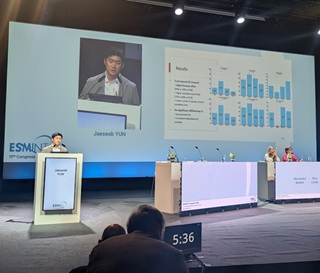
Dual-layer stent retrievers—as opposed to traditional single-layer alternatives—may offer improved first-pass effect (FPE) rates and more complete recanalisation outcomes when utilised as a first-line treatment option in cancer-related strokes. That is according to new research presented by Jaeseob Yun (Keimyung University College of Medicine, Daegu, South Korea) at this year’s European Society of Minimally Invasive Neurological Therapy (ESMINT) annual congress (3–5 September, Marseille, France).
Yun began by noting that previous studies have indicated cancer-related ischaemic strokes are typically caused by thrombi that are particularly rich in platelets and fibrin but have below-average levels of red blood cells.
“This matters because clot composition directly affects thrombectomy performance,” he explained. “However, the optimal strategy [for cancer-related stroke] remains largely unknown.”
Yun went on to state that the stiffness and increased friction coefficient associated with platelet/fibrin-rich thrombi may result in reduced stent engagement and an increased thrombus-vessel interaction during thrombectomy procedures, potentially making these treatments less effective. Against this backdrop, Yun and his colleagues hypothesised that—owing to improved clot integration—dual-layer stent retrievers have the potential to outperform single-layer stent retrievers in removing these types of thrombi.
They conducted a retrospective analysis of a prospective cohort of 78 patients with cancer-related stroke who underwent thrombectomy from 2011–2024. Within this group, 29 patients were treated using a combined technique (stent retriever plus aspiration), while 35 were treated via stent retriever only and 14 were treated with contact aspiration. Among the 64 patients whose treatment involved stent retrievers, 13 received the dual-layer Embotrap device (Johnson & Johnson), and 51 received a single-layer device—either Solitaire (Medtronic; n=35) or Trevo (Stryker; n=16).
Yun and colleagues’ primary outcomes of interest were the rates of FPE and symptomatic intracranial haemorrhage (ICH), although a number of other metrics including final reperfusion status, successful reperfusion within three passes, total number of passes, procedure times, functional independence and mortality were also assessed.
Analyses of the full 78-patient cohort revealed no significant differences between combined, stent retriever-only and contact aspiration thrombectomy techniques regarding efficacy, safety, and clinical outcomes. Yun noted that, while a high mortality rate of 86.2% was observed in patients treated via a combined technique, this was ultimately attributed to underlying cancer prognoses as opposed to the thrombectomy treatment itself.
However, more pronounced between-group discrepancies were found when the researchers compared the dual- and single-layer stent retrievers utilised within their patient population. The dual-layer Embotrap device achieved a higher FPE rate (54%) versus both Trevo (25%) and Solitaire (14%), and a superior rate of complete reperfusion as per a thrombolysis in cerebral infarction (TICI) score of 3, at 77% versus 44% and 31%, respectively. In addition, Embotrap was associated with a lower median number of passes (n=1) versus Trevo (n=2) and Solitaire (n=3), as well as demonstrating a shorter average procedure time compared to its single-layer contemporaries.
Yun further reported that there were no statistically significant differences between these three stent retrievers regarding rates of symptomatic ICH, functional independence and mortality.
“In summary, the dual-layer stent retriever showed greater efficacy without compromising safety,” he added, also relaying that these trends remained consistent following adjusted multivariable analyses, bolstering the notion that dual-layer devices may enable faster and more complete recanalisation than conventional stent retrievers in cancer-related stroke treatments. “Although the sample size was [quite small], these findings have important clinical implications.”