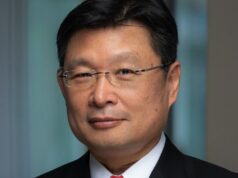
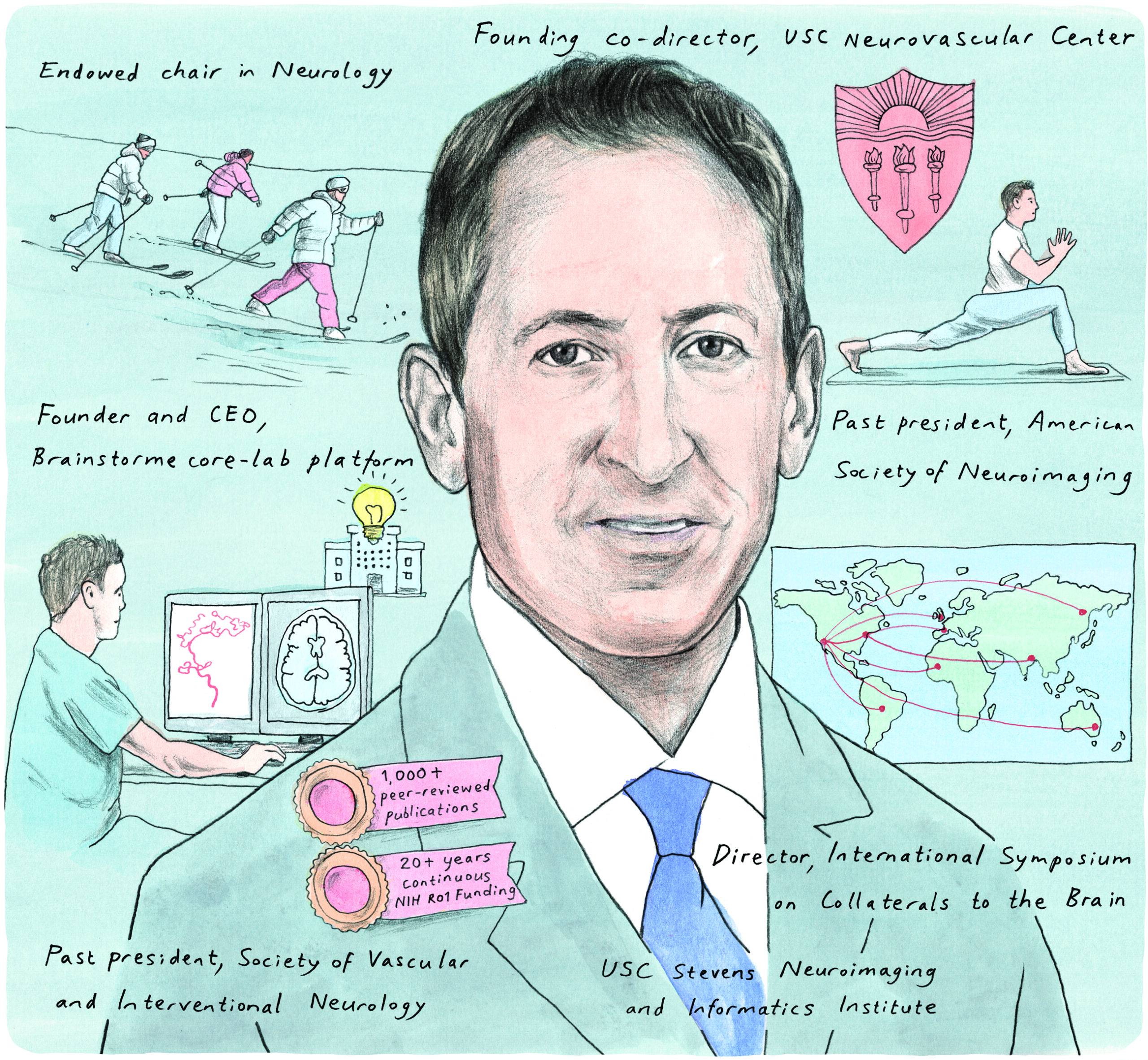
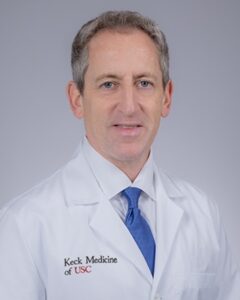
Despite his training as a neurologist, David Liebeskind (Los Angeles, USA) has never accepted the constraints of a single specialty, title or lane. Over more than three decades, that refusal to be boxed in has translated into one of the most expansive careers in contemporary neurovascular medicine—encompassing clinical care, imaging science, research, global trial leadership, entrepreneurship, and mentorship. With over 1,000 peer-reviewed publications, continuous US National Institutes of Health (NIH) R01-equivalent funding as principal investigator (PI) dating back more than 20 years, and leadership roles across neurology, radiology and neurointervention, Liebeskind has helped define the integration of advanced imaging into modern stroke care. Additionally, through a recurring international meeting dedicated to brain collaterals, he has convened clinicians and scientists from more than 95 countries, helping to elevate collateral circulation from a niche concept to a central pillar of stroke science. In 2025—after more than two decades at the University of California Los Angeles (UCLA)—he moved to the University of Southern California (USC) as founding co-director of the USC Neurovascular Center, endowed chair in neurology, and professor of neurology, neurological surgery and radiology, anchoring what he describes as a new regional vision for neurovascular medicine across Southern California. Speaking with NeuroNews, Liebeskind reflects on a career built around imaging, physiology, and collaboration—and on what still lies ahead.
Why were you initially drawn to medicine?
It was almost genetically determined. Medicine—and radiology in particular—runs through my extended family across multiple generations. Ironically, that’s exactly why I resisted it. My early instincts pushed me toward engineering; a discipline rooted in testable systems and reproducible logic. I carried that mindset into medicine, approaching neurology not as a static specialty but as an applied science—one uniquely suited to quantitative analysis through imaging. The brain is the only organ you can’t replace and, yet, it’s one of the few that you can image in three dimensions, repeatedly, and in real time. That makes it an ideal system for engineering-based thinking.
I have deliberately avoided being siloed as either a proceduralist or a diagnostician. I didn’t want to live exclusively in an operating room or a reading room. I wanted to work across boundaries. That philosophy ultimately led to a rare distinction, as I remain the only non-interventionist ever to serve as president of the Society of Vascular and Interventional Neurology (SVIN)—a role that positioned me to bridge neurology, radiology, neurosurgery, industry and regulatory science without professional competition.
Who have your key mentors been?
Early on, Fernando Viñuela showed me that academic medicine didn’t have to be one-dimensional. He was deeply clinical, intensely academic, committed to training, and unafraid to work with industry before that was fashionable. That model—clinical grounding combined with innovation and global engagement—became foundational. The future of academic medicine depends on that kind of multidimensional thinking, but it certainly wasn’t the dominant paradigm when I started.
How do you reflect on your time at UCLA, and why did you decide to move to USC?
When I arrived at UCLA more than 30 years ago, there were no approved drugs or devices for acute ischaemic stroke. I trained during the earliest days of intravenous thrombolysis and witnessed the birth of endovascular therapy—including the first investigational device exemption (IDE) for mechanical thrombectomy. Over the ensuing decades, I helped build UCLA into a global hub for stroke imaging, collateral physiology and trial-based neurovascular research—directing imaging cores, training programmes, and one of the most productive stroke research enterprises in the world.
Additionally, my completion of a business degree at the UCLA Anderson School of Management has further shaped how I approach academic leadership, innovation strategy, and the integration of clinical medicine with entrepreneurship.
The move to USC wasn’t about leaving something behind; it was about building what comes next. At USC, I am now helping to design an integrated, region wide neurovascular innovation hub, linking comprehensive stroke centres, community hospitals, imaging infrastructure and research programmes across Southern California, in close partnership with the USC Stevens Neuroimaging and Informatics Institute. We have named this ecosystem ‘ASCEND’. It’s an environment that aligns with where neuroscience, imaging and precision medicine are going.
Could you outline the origins of Brainstorme and the evolution of imaging core labs?
Long before centralised imaging adjudication became standard, I was already doing it. I started performing blinded, independent imaging reads in the late 1990s—before ‘core labs’ were really a thing in neurovascular trials. That work expanded across virtually every neurovascular condition, from large- and distal-vessel occlusions to intracranial atherosclerosis, vasospasm, aneurysms, subdural haematoma, and adjunctive neuroprotection. Over time, it became clear that imaging could serve not just as an endpoint, but as a strategic pathway to regulatory approval and mechanistic insight.
To support that vision at scale, I founded and became the chief executive officer (CEO) of Brainstorme—a cloud-based neuroimaging core-lab platform now operating globally enabling real-time image transfer, labelling, adjudication and regulatory-grade archiving 365 days a year. We essentially built the system we wished existed; now it does. And, looking forward, Brainstorme is evolving beyond trials. We are carefully, deliberately moving toward a direct-to-consumer imaging repository. Shared access to images—between hospitals, clinicians and, eventually, patients—is still surprisingly rare. That has to change.
Where is the ideal role for artificial intelligence (AI) in neuroimaging?
AI will not replace expert adjudication. But, it can dramatically enhance speed, consistency, and real-time decision support—especially at enrolment and triage. For me, the key question is practical value. AI has to deliver actionable information on the timescale of clinical decision-making. Otherwise, it’s just interesting software.
Which of your accomplishments are you proudest of?
Despite a résumé that includes unmatched publication volume, decades of NIH funding, and leadership in many of the field’s most influential trials, I wouldn’t necessarily say it’s any of those metrics.
The most meaningful achievement is seeing colleagues and trainees believe in a vision—and then surpass you. Over the course of more than two decades, spanning multiple generations, I have trained dozens (>80) of vascular neurology fellows and clinician scientists, with many now leading major academic programmes around the world. Your real legacy is the people; that’s how the field moves forward.
Which of the studies you have been involved with has had the most significant impact?
Science is iterative, and no clinical trial is definitive in the sense that it ends the debate on a particular topic. There have been studies that have nailed the question at hand with an unequivocally positive outcome, but that doesn’t definitively answer the larger questions in the field—and I don’t think any trial is meant to do so.
I’ve always argued that it’s not the nature of the results, but having a detailed, high quality, trustworthy methodology, that defines the ultimate value of a trial. And, in terms of future clinical research, I think what we need is productive science that brings more breakthrough products and devices to patients.
What is the biggest challenge currently facing the neurovascular space?
The largest hurdle that needs to be overcome in the field of neurovascular disorders is the artificial split between physicians and researchers in different specialties. Each practice is siloed, and things have been politically charged or divisive between specialties and subspecialties in the past, which is completely unnecessary and doesn’t help patients.
In order for us to work most effectively across specialty lines, institutions, or regions, those hurdles need to be overcome. Learning how we can collaborate with colleagues—locally, but also around the world—is one of the most valuable and productive things we can achieve.
What excites you most about the field right now?
The expansion is extraordinary. Drugs, devices, diagnostics, AI—everything is colliding. I am particularly optimistic about combination strategies, where imaging guides the pairing of therapeutics and interventions. Imaging is the connective tissue. It tells you which therapy, for which patient, at which moment.
What does your life beyond medicine look like?
Outside the hospital and research arenas, I remain physically and intellectually active. I ski whenever time allows—often with my family—and practice daily yoga, which serves as an hour of total reset. Frequent international travel also provides perspective and fuels creativity.
FACT FILE
Current appointments:
- Endowed chair in neurology; professor of neurology, neurological surgery and radiology, USC
- Founding co-director, USC Neurovascular Center
- Founder and CEO, Brainstorme
Previous appointments:
- Professor of neurology; director of stroke imaging and neurovascular research programmes, UCLA
Education and training:
- MD, New York University
- Internship, Harvard Medical School
- Residency, neurology, UCLA
- Fellowship, cerebrovascular disease and stroke, UCLA
- MBA, UCLA
Leadership and honours:
- Past president, SVIN; American Society of Neuroimaging
- Fellow, American Heart Association; World Stroke Organization; American Academy of Neurology
- 1,000+ peer-reviewed publications (h-index, >128; 86,000 citations)