
The efficacy and overall safety profile of endovascular therapy (EVT) in large-core ischaemic stroke patients has been reaffirmed by the findings of ATLAS—a systematic review and meta-analysis of close to 2,000 patients included in six different randomised controlled trials (RCTs) evaluating the procedure.
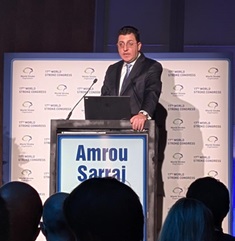
Detailing these new patient-level data analyses at the 2025 World Stroke Congress (WSC; 22–24 October, Barcelona, Spain), Amrou Sarraj (Case Western Reserve University, Cleveland, USA) noted that the trials in question—ANGEL-ASPECT, LASTE, RESCUE-Japan LIMIT, SELECT2, TENSION and TESLA—all produced results suggesting clinical benefits with EVT versus medical management.
“However,” he continued, “they chose different imaging modalities, were run in different healthcare systems, and had major differences in [endpoints], which led to heterogeneity in the patient populations and in the treatment effects. In addition, when you go into clinical practice after seeing these results, there are curiosities regarding certain subgroups in terms of different [infarct] sizes, treatment timings and imaging profiles.”
Sarraj, principal investigator for SELECT2, stated that these discrepancies led him and other leading investigators of the six large-core RCTs to come together and improve the current understanding of EVT in this population of patients with particularly severe strokes.
The primary endpoint for ATLAS was 90-day modified Rankin scale (mRS) shift, while secondary outcomes of interest included rates of mRS 0–2 and 0–3 as well as symptomatic intracranial haemorrhage (sICH), neurological worsening and mortality. A total of 1,886 patients were included in the meta-analysis.
“Just to put this into context,” Sarraj noted, “the HERMES meta-analysis that revolutionised stroke care in patients with smaller cores had a cohort of 1,287.”
In addition to highlighting the fact that the two overall study groups—EVT plus medical management and medical management only—were well-balanced in terms of baseline characteristics, Sarraj commented that roughly 20% of patients had an Alberta stroke programme early computed tomography score (ASPECTS) of 0–2, largely owing to the significant enrolment of these especially extensive stroke cases in LASTE and TESLA.
With five of the six RCTs having met their primary endpoint, and TESLA having also shown trends favouring EVT with positive per-protocol analysis findings, Sarraj stated that—“as expected”—ATLAS also met its primary endpoint, as per an adjusted general odds ratio (aGenOR) of 1.63 favouring the EVT cohort. Furthermore, the mRS 0–2 rate was 19.5% with EVT versus 7.5% with medical management, and the mRS 0–3 rates were 36.6% versus 19.8%, respectively, between the two groups.
“Importantly, mortality was significantly reduced,” the presenter added, highlighting rates of 31% with EVT and 37% without. “Again, to put things into context, [EVT] is now the first reperfusion therapy that we can say saves lives in this population.”
Regarding additional safety-related endpoints, Sarraj reported a statistically significant increase in sICH rates with EVT compared to medical management (5.5% vs 2.7%, respectively), and proportions of neurological worsening of 22% with EVT versus 17% with medical management.
Sarraj went on to highlight forest plots indicating that EVT retained its efficacy across all clinical and imaging-based subgroups of interest, including in patients with ASPECTS 0–2 as well as scores of 3, 4, and 5. He also relayed that the treatment effect of EVT persisted in both the early (<6 hours) and late (6–24 hours) time windows. However, more granular analyses showed that, while the groups with ASPECTS 0–2 and ASPECTS 3–5 treated in the early time window benefitted from EVT—as did those with ASPECTS 3–5 treated beyond six hours—the procedure did not demonstrate a meaningful benefit in ASPECTS 0–2 patients treated in the later window after symptom onset, although Sarraj cited the small number of enrolments of these patients as a potential confounding factor here.
The presenter also noted that blinded, centralised adjudication of all the core-lab imaging information from each of the six individual RCTs, including data on ASPECTS, ischaemic core volumes and mismatch profiles, will be conducted shortly.
“We conclude that ATLAS demonstrates the overwhelming benefit of EVT in stroke patients with a large core, across a spectrum of different inclusion criteria, imaging modalities, healthcare systems, geographies and ethnicities, which speaks volumes on the generalisability of these data,” Sarraj added. “There were consistent improvements in functional independence [mRS 0–2] and independent ambulation [mRS 0–3], and, while sICH and neurological worsening increased, this did not outweigh the overall clinical benefit seen with EVT, nor the fact that mortality was reduced. This is important because it establishes and emphasises the superiority of EVT over medical management in a population that accounts for around 20% of all LVO [large vessel occlusion] strokes.”