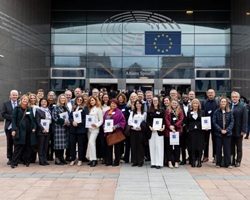
 Last week, stroke took centre stage at a European parliament event in Brussels, Belgium, where policymakers, people with lived experience, healthcare professionals, researchers, support organisations and advocates came together to call for urgent action to address the present lack of stroke research, and persistent inequalities in stroke prevention, treatment and long-term care across Europe. That is according to a joint press release from the European Stroke Organisation (ESO) and Stroke Alliance for Europe (SAFE).
The recent World Health Organization (WHO) Global Status Report on Neurology highlights the fact that stroke is the top neurological disorder contributing to health loss globally—and Europe faces more than 1.1 million strokes each year, causing nearly 460,000 deaths, while close to 10 million people live with the disease’s long-term effects. Stroke is also the second-leading cause of death and the leading cause of adult disability in Europe.
In addition, the economic burden of stroke—which is already “immense”—is projected to rise to €86 billion by 2040 without urgent reform, the release details.
The recent event on Tuesday 14 October in Brussels, ‘Closing the gaps in stroke care: a call to action for Europe’, was hosted by members of European parliament (MEPs) Billy Kelleher from Ireland and Romana Jerkovic from Croatia, as well as the ESO and SAFE. It highlighted the “critical need to act now” and embed stroke as a key pillar within the upcoming European Union (EU) Cardiovascular Health Plan and broader brain health strategies, using the Stroke Action Plan for Europe (SAP-E) as the framework for this.
“Too many lives are cut short or permanently altered because access to prevention, acute treatment, rehabilitation and long-term support depends on where you live,” said SAFE director general Arlene Wilkie. “With the upcoming publication of the Stroke Action Plan for Europe, we now have a clear roadmap. What we need is EU leadership to help member states turn this evidence into action.”
In addition to MEPs Kelleher and Jerkovic, the event featured contributions from Marianne Takki of the Directorate-General for Health and Food Safety (DG SANTE) and Katherine de Bienassis of the Organisation for Economic Co-operation and Development (OECD), as well as people with lived experience of stroke.
The ESO-SAFE press release notes that discussions underscored the “urgent need” for a coordinated European approach to closing the gaps in stroke care, supported by stronger alignment between EU and national health policies, across five key areas:
- Prevention—systematic screening for hypertension and atrial fibrillation, sharing best practices across member states
- Acute care—expanding access to dedicated stroke units, emergency coordination and life-saving interventions like thrombolysis and thrombectomy
- Rehabilitation—ensuring early, intensive, multidisciplinary rehabilitation with EU support for scaling up community and outpatient services
- Life after stroke—embedding long-term support, including mental health and reintegration programmes in national frameworks
- Research and monitoring—establishing EU-wide registries and quality indicators, and embedding stroke in EU health and research agendas
“As the EU prepares to shape its cardiovascular and brain health priorities, stroke must be recognised as a cornerstone issue,” said ESO president Simona Sacco (University of L’Aquila, L’Aquila, Italy). “This is the moment to move from fragmented efforts to a coordinated European approach.”
“I have lived experience of stroke; I know firsthand how life can change in an instant, and how much harder recovery could have become if support would have been fragmented or simply not there,” added Melinda Roaldsen (University Hospital of North Norway, Tromsø, Norway). “Too many Europeans are left to navigate complex health systems on their own, facing barriers to rehabilitation, returning to work and rebuilding their lives. This event has given us a chance to change that. By asking MEPs and policymakers to bring stroke into the heart of EU health policy, they have an opportunity to make sure that every person, no matter where they live, has timely access to treatment, quality rehabilitation and long-term support. For me, this isn’t just about statistics or policy. It’s about dignity, independence and hope for millions of people and families across Europe.”